Why This Number Matters More Than the Headline
When the Alternative für Deutschland secured 20.8% of the vote in February 2025, crossing above one-fifth of the German electorate for the first time in the post-war democratic period, the international response fell into predictable camps. Some outlets treated it as an alarming surge. Others downplayed it by noting that Friedrich Merz and the CDU/CSU bloc finished ahead with roughly 28.5%, suggesting business as usual. Both reactions miss what actually happened: Germany’s political landscape went through a structural shift that redistributes power in ways affecting not just German politics, but the entire European project.
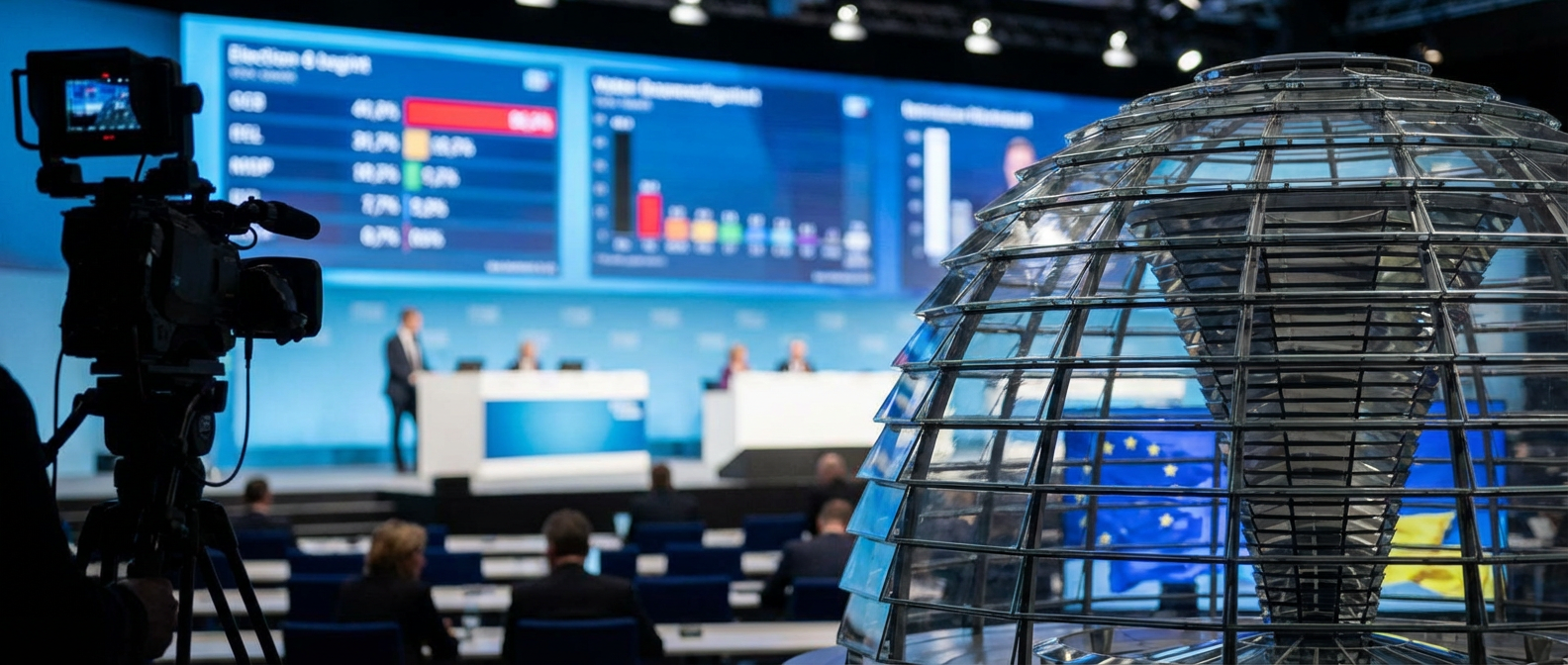
The real story is not that the far-right won. It is that the rules governing what happens after elections have become unstable. Germany established an informal but ironclad “firewall” after the war, an understanding that mainstream parties would not govern with the far-right, full stop. That firewall still technically stands. Merz moved forward with coalition formation without the AfD. But its survival depends on voluntary restraint by actors who now face unprecedented pressure from voters to abandon it. That distinction between formal rules and the political will to enforce them is where the European implications start to become clear.

The Coalition Math and the Firewall’s Fragility
Merz inherited a genuinely constrained arithmetic problem. The CDU/CSU and the SPD together do not command a majority without a third coalition partner. The Greens and the Free Democrats remain options, though their combined strength in the new Bundestag is modest. Meanwhile, the AfD, sitting at over one-fifth of all seats, is the second-largest bloc. In raw procedural terms, excluding them from every negotiation and every vote creates constant friction. The firewall persists, but it requires the CDU to turn away from what looks like untapped legislative strength.
This is where the American or British observer might assume the math resolves naturally. It does not. Germany’s coalition culture emphasizes consensus and compromise across parties. Isolating one-fifth of the legislature creates structural problems: legislative gridlock on certain issues, constant accusations that decisions are being made by an illegitimate elite, and mounting pressure on centrist parties to prove they are not ignoring legitimate concerns. The firewall survives through active institutional work, not through structural inevitability. That work becomes harder each cycle the AfD maintains or grows its support.
What European Integration Looks Like When the Firewall Starts to Bend
The European implications flow directly from this fragility. Germany’s relationship with the EU has been foundational to EU cohesion for decades. A Germany that gradually abandons its post-war consensus on European integration does not simply become a larger Poland or Hungary. It unravels the entire architecture, because Germany’s economic and political weight means its moves carry systemic consequences. The AfD crossing 20% signals that this unraveling has begun, even if Merz’s coalition keeps it manageable in the short term.
Start with the European Parliament’s party structures. The Identity and Democracy group, which previously hosted AfD members, has faced reconfiguration precisely because mainstream conservative parties cannot indefinitely share a political family with actors who question European integration itself. But this reconfiguration does not resolve the underlying problem. It just moves it. If the AfD maintains a 20-percent-plus baseline, it will keep reshaping European party alignments, pushing other conservative parties toward positions on sovereignty and immigration that strain EU cohesion from within.
Trust in EU institutions among German respondents collapsed from 53% in early 2023 to 46% by January 2025, according to Eurobarometer data. That seven-point drop in two years signals something specific: the AfD’s growth correlates with declining confidence in European structures. This is not necessarily causation, but it reflects a real phenomenon. As the AfD normalizes critiques of EU decision-making, supranational authority, and burden-sharing arrangements, it shifts what centrist politicians can credibly defend without appearing out of touch with voter sentiment. The firewall holds in the government formation process. It crumbles in the background conversation about whether the EU’s current form actually serves German interests.
The Specific Vulnerabilities: Immigration, Sovereignty, and Fiscal Policy
The AfD’s specific policy platforms reveal where the strain on European integration will intensify. The party is fundamentally skeptical of EU fiscal transfers, critical of immigration as conducted through European frameworks, and committed to reasserting national sovereignty over supranational institutions. None of these positions is fringe within Europe. Hungary and Poland have governed using similar rhetoric. But when a party articulating these views commands one-fifth of a major economy’s legislature, the balance shifts.
Consider fiscal policy. Germany has historically resisted the kind of eurozone fiscal union that southern European states want. German political culture emphasizes budget discipline and skepticism toward redistribution. The AfD pushes this skepticism into a fundamental questioning of whether Germany should remain in a monetary union where its fiscal discipline subsidizes other members’ spending. Merz’s coalition government will not adopt this position. But as the AfD’s share of the electorate stabilizes at 20 percent, future CDU governments will find it harder to move toward the kind of eurozone integration that EU architects believe the currency union requires for long-term stability. The firewall does not stop this shift. It just delays its political consequences.
Immigration presents a similar dynamic. The AfD’s opposition to immigration flows through EU asylum frameworks and free movement rules. Again, these critiques have mainstream European expressions. But the AfD articulates them with an intensity that forces the mainstream right to match its tone or risk losing voters. The result is not necessarily a policy revolution overnight. It is a gradual rightward shift in what centrist parties can promise on border control, integration timelines, and EU-level asylum standards. European integration depends on managed migration. As one of Europe’s largest economies drifts toward viewing migration as a threat to integration rather than a feature of it, EU policy-making becomes more defensive and less ambitious.
Beyond the Firewall: What Comes Next
The immediate answer is clear: the firewall holds through this cycle. Merz has formed a governing coalition. The AfD remains isolated from direct governmental power. But this tells us almost nothing about the medium and long-term European trajectory. The relevant questions are whether the AfD’s 20.8% is a stable new floor or a launchpad toward higher support, whether future CDU leaders will maintain Merz’s discipline on the firewall as party pressure mounts, and whether the gradual mainstreaming of AfD talking points on sovereignty and immigration alters the terms of the European integration debate even without the party holding formal power.
For those tracking European cohesion, the German election matters less as a government-formation story and more as a signal about where the political center of gravity has shifted. When one-fifth of Europe’s largest economy supports a party fundamentally skeptical of supranational authority, European institutions face headwinds that no amount of procedural isolation can eliminate. That is not a prediction of EU collapse. It is an observation about structural political change.
The detailed election results and coalition formation process are documented in official sources, and the European Council on Foreign Relations has offered substantial analysis of these implications. What remains to be tested is whether Germany’s political establishment can articulate a compelling vision of European integration that addresses the grievances the AfD has mobilized. Without that reframing, the firewall survives as procedure while the underlying political consensus that made it durable keeps eroding. That distinction between formal rules and living consensus is where European futures are actually decided.