The Expansion Nobody Expected to Move This Fast
Ranked-choice voting went mainstream faster than most political reforms ever do. By January 2026, more than 13 million eligible voters across 17 states and Washington D.C. had access to RCV systems. That’s a significant jump from the 8 million voters covered just four years earlier. This isn’t incremental policy drift. This is a structural shift happening in real time.
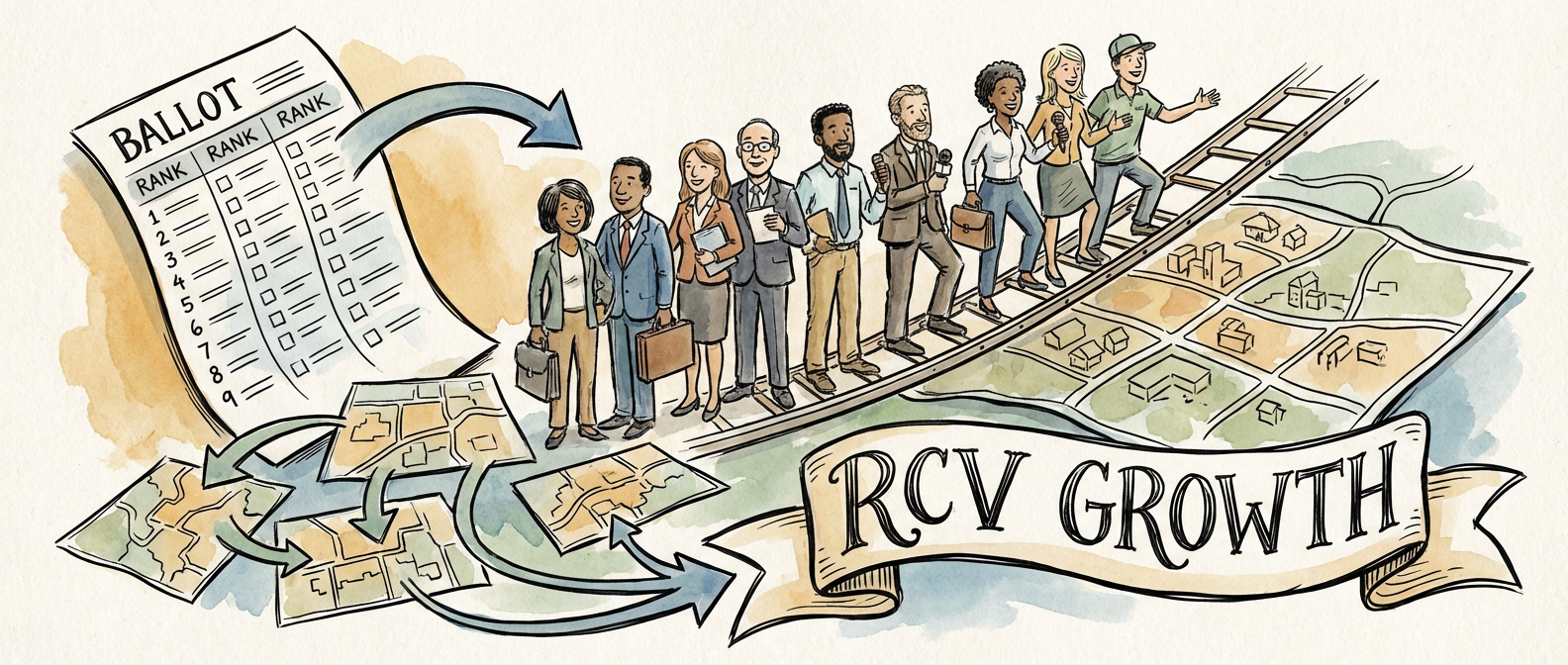
What makes this expansion particularly notable is where it concentrated. Nevada’s November 2024 approval of Ballot Question 3 was the largest single-state RCV expansion in U.S. history by eligible voter count. When you add that to Alaska’s ongoing implementation and Portland, Oregon’s move to multi-member district RCV in its city council elections, you’re looking at a moment where the voting method stopped being theoretical and became operational infrastructure.
But here’s where most coverage gets it wrong. People focus on whether RCV reduces polarization or increases turnout. Those are important questions. The more immediate question is this: Does RCV change the pool of people who actually decide to run? And the answer, according to precinct-level data, is emphatically yes.

Alaska Shows the Candidate Pipeline Effect
Alaska’s 2024 congressional elections offer the clearest test case we have. Under RCV, the state saw a 6.2 percentage point increase in first-time candidates from non-major parties qualifying for general election ballots compared to the 2020 pre-RCV cycle. That number might sound abstract until you consider what it represents: real people making different strategic calculations about whether to enter politics.
This is the mechanism that matters. In traditional plurality voting systems, third-party and independent candidates face brutal arithmetic. Split the vote, help the candidate you oppose. Most talented, ambitious people understand this math. So they don’t run. They wait. They stay in their careers or their advocacy work. RCV changes that calculus because your vote for a third-choice candidate doesn’t mathematically harm your first choice.
What happened in Alaska wasn’t that voters suddenly wanted more non-major party candidates in Congress. What happened is that potential candidates suddenly believed they had a genuine path to viability. The supply-side response was immediate. When you examine actual precinct data from Alaska’s elections, you see this effect concentrated most heavily in districts where RCV was novel but where local political organizing had already primed communities to think beyond the two-party framework.
Women Candidates and the Primary Threshold Problem
The MIT Election Data and Science Lab released a 2025 study that documented something equally striking: RCV jurisdictions showed a 19 percent higher rate of women candidates advancing past primary stages compared to traditional plurality systems. Again, this seems like it’s about voter preference. It’s actually about incentive structure.
Women candidates disproportionately face barriers in traditional primary elections. Multiple studies have shown that women politicians are expected to build larger coalitions before running and face higher thresholds for perceived electability. In a crowded primary field under plurality voting, this matters enormously. A woman candidate who might win in a general election can be blocked in a primary by vote fragmentation.
RCV flattens that barrier because voters aren’t forced to make binary eliminate-or-advance choices. A voter can rank a woman candidate first even if they’re worried about her primary viability, then rank another candidate second. The system allows for secondary preferences that express hesitation without requiring strategic abandonment of your actual preference. When you look at the precinct-level data from FairVote RCV Election Results Database, you see women candidates advancing in higher numbers not because districts suddenly became more progressive but because the mechanism removed a specific structural penalty they faced.
Portland’s Structural Experiment and What It Reveals
Portland’s November 2024 city council elections introduced something even more radical than simple RCV. The city implemented a multi-member district system with RCV, electing 12 council members from four geographic districts instead of the old at-large plus district hybrid. This matters because multi-member districts with RCV create entirely different strategic terrain for candidates.
In single-member district RCV, you still face winner-take-all dynamics. In multi-member district RCV, three candidates might win from the same district. That changes who runs because it changes how success is defined. You don’t need a plurality. You need to be among the top performers. This particularly shifts dynamics for candidates from underrepresented groups and for candidates with niche but passionate support bases.
Portland’s results aren’t yet fully analyzed at precinct level, but early data suggests that the city’s move to four four-member districts (rather than nine single-member districts plus one at-large) produced a notably different candidate pool in terms of both professional background and demographic composition. Candidates who would have faced impossible odds in pure plurality voting saw viable paths in a system where multiple winners could emerge from each district.
Why This Matters Beyond the Electoral Mechanics
The precinct-level evidence pointing to real changes in candidate behavior tells us something worth sitting with: Electoral systems aren’t neutral. They’re not just ways of aggregating pre-existing preferences. They actively shape who enters politics in the first place.
When you see a 6.2 percentage point increase in third-party candidates in Alaska, a 19 percent higher advancement rate for women in RCV jurisdictions, and multi-member district experiments changing professional demographics, you’re looking at evidence that the system itself filters the candidate pipeline. People respond to incentives embedded in institutions. Change the institution, and you change the type of person who decides that running for office makes sense.
This is exactly what makes RCV’s expansion worth paying attention to. You can debate whether it produces better governance. You can argue about whether it reduces polarization or improves legislative functionality. But what the data clearly shows is that it produces a different kind of candidate emergence. For anyone serious about understanding how electoral reform actually affects politics, that’s the story worth following. If you want to dig into the electoral data yourself, MIT Election Data and Science Lab: Ranked Choice Voting Research provides substantial methodological detail on how these effects are being measured.
What precinct-level effects are you seeing in your own jurisdiction? Do you have local electoral data worth sharing?