Why Western Sanctions Have Not Changed Russian Elite Behavior

View of the Kremlin and Moscow skyline

In the weeks after February 2022, Western capitals launched what they called an economic war against the Kremlin. The sanctions packages were historic in scope: central bank reserves frozen, major banks cut off from SWIFT, personal asset freezes and travel bans against oligarchs, export controls on semiconductors and dual-use goods. The intent was unambiguous—to squeeze the Russian elite so hard that it would either break with Vladimir Putin or force a change in course. Two years later, the Russian elite has not broken, has not defected en masse, and has not pushed the system in a different direction. To understand why, you have to look past the surface spectacle of yacht seizures and Swiss bank accounts.

The analytical error that underpins much Western commentary is the assumption that the Russian elite behaves like a transnational capitalist class whose primary loyalty is to wealth preservation in Western jurisdictions. That was always a partial reading. Sanctions have revealed something else. They have shown how the elite has reorganised itself around a logic of survival, state dependency, and a nationalism that is more structural than sentimental.

The Architecture of Elite Dependence

Sanctions theory borrows heavily from the idea of elite defection. If the people who own the assets, run the enterprises, and manage the state apparatus feel personal pain, they will exert pressure on the leader. The problem in Russia is that the relationship between the elite and the state is not one of independent capital checking political power. It is a patronage pyramid in which status, income, and physical security are all mediated by proximity to the centre.

Modern skyscrapers in Moscow's business district

A senior official or state company executive in Moscow does not derive his position from a diversified global portfolio. He derives it from a phone call, a signature, or a seat at a security council meeting. His London flat and his children’s British schools were perks of a previous era. They are not the source of his power. When the flat is frozen and the school sends a polite letter of withdrawal, the response is not to challenge the Kremlin. It is to double down on the one source of protection that remains—the state itself.

This is not armchair psychology. It is structural. The Russian economy is dominated by state-owned and state-linked enterprises. According to the IMF, the state’s share in the banking sector exceeds 60%. In oil and gas, the figure is higher still. The individuals who run these enterprises are not entrepreneurs in the conventional sense. They are nomenklatura capitalists whose property rights are conditional. Sanctions on their personal assets only tighten that conditionality.

Reshoring of Assets and the New Redistribution

One of the most significant behavioural shifts has been the rapid reshoring of capital. Before 2022, Cyprus and the British Virgin Islands were the visible bookmarks of Russian wealth. Since then, a combination of sanctions enforcement and Russian counter-measures has forced a repatriation of assets. The Kremlin has encouraged this with a new legal infrastructure—special administrative regions on Russky Island and in Kaliningrad, forced re-domiciliation of holding companies, and a quiet but persistent campaign of pressure on businessmen to bring money home.

This reshoring is not a return to Soviet autarky. It is a redistribution of economic control within the elite. Those who comply and demonstrate loyalty gain access to assets vacated by departing Western firms and by less agile Russian competitors. The state bank VTB, the gas giant Gazprom, and the agricultural conglomerates have all absorbed formerly foreign-owned operations. For the elite insider, sanctions create a closed market with fewer players and higher state-guaranteed margins. The incentive structure has flipped: staying inside the fortress is now more lucrative than maintaining an offshore escape route.

The Nationalist Turn Is Not a Performance

Western analysts often dismiss elite patriotism as a theatrical posture adopted for television cameras. That interpretation misses the institutionalisation of nationalist ideology over the past decade. Since the 2014 sanctions following Crimea, the Russian state has systematically tied elite privilege to a narrative of civilisational struggle. The presidential administration, the Ministry of Defence, and the security services have built a framework in which loyalty is demonstrated through public alignment with the “special military operation” and the broader confrontation with the West.

St. Basil's Cathedral and Red Square in Moscow

This is not mere rhetoric. The practical consequences are severe. The children of senior officials serve in the armed forces or in state-sponsored youth organisations. Businessmen fund volunteer battalions and donate to occupied territories. The sanctions regime itself is used as a propaganda tool: the elite is told, over and over, that the West wants to destroy Russia, and that any sign of internal dissent will be treated as treason. In this environment, the cost of defection is not just financial—it is existential. The fate of those who tried to leave, like the former oil executive who died in ambiguous circumstances after criticising the war, serves as a constant reminder.

The nationalist turn also has a generational dimension. The younger cohort of officials and businessmen, those in their forties and fifties, came of age during the Putin era. They have no memory of Soviet decline and no nostalgia for 1990s integration with the West. For them, the world is defined by great-power competition, and Russia’s role is to be a pole in a multipolar system. Sanctions confirm that worldview instead of undermining it.

The Security Apparatus as Economic Actor

A dimension often overlooked in sanctions analysis is the direct economic role of the security services. The FSB, the Ministry of Defence, and associated structures are not simply consumers of budget resources. They have become significant economic operators in their own right. Through procurement contracts, control over strategic enterprises, and informal ownership stakes, the siloviki have carved out a parallel economic domain that is almost entirely insulated from Western financial pressure.

When sanctions hit the banking sector, the security apparatus could redirect state funds and offer alternative financing channels. When technology exports were blocked, the same apparatus developed smuggling networks and reverse-engineering programmes that, however inefficient, keep critical sectors running. This economic role gives the security bloc an institutional interest in the continuation of the confrontation. Every new round of sanctions strengthens their claim on resources and their argument that the country must be run as a mobilised fortress.

The Limits of Personal Sanctions

Personal sanctions on oligarchs—asset freezes, visa bans, the seizure of superyachts—generate headlines. They have almost no effect on elite behaviour. The reason is simple: the oligarchs who matter politically are those who already had their assets structured for precisely this contingency. Long before 2022, anyone close to the Kremlin understood that Western jurisdictions were not reliable. Trusts were restructured. Assets shifted to non-Western jurisdictions. Legal ownership was placed at arm’s length.

The individuals who were caught out—those with yachts in Italian ports and mansions in Mayfair—were either politically marginal or strategically sacrificed. Their public humiliation serves the Kremlin’s interests by demonstrating to the rest of the elite what happens when you trust the West. The lesson absorbed in Moscow boardrooms is not “sanctions hurt, so we should change policy.” It is “sanctions hurt, so we should cut all remaining ties.”

In addition, the sanctions have accelerated a process of elite rotation. The older generation of oligarchs who made their fortunes in the 1990s and 2000s and had deep personal connections to Europe are being replaced by a new class of state-dependent managers. These are people whose entire career has been spent inside the system, whose assets are in Russian real estate and domestic bonds, and whose worldview has been shaped by state media. They are, by design, sanctions-proof.

The Failure of Secondary Sanctions

The United States and the European Union have increasingly turned to secondary sanctions—targeting banks and companies in third countries that facilitate trade with Russia. The logic is sound: if Western firms cannot trade with Russia, prevent others from doing so. In practice, the enforcement has been patchy and has created a two-tier global economy that Russia can exploit.

China, India, Turkey, the UAE, and Central Asian states have not joined the sanctions regime. Trade data from these countries shows a sharp increase in exports to Russia, particularly in machinery, electronics, and luxury goods. Chinese car sales in Russia have tripled. Turkish exports of machinery have doubled. The UAE has become a hub for Russian gold trading and cryptocurrency transactions. The Russian elite has adapted by routing its consumption and investment through these channels, often with the quiet cooperation of local elites who see a profitable opportunity.

The Kremlin has also proven adept at using informal networks—the so-called “parallel imports” that bring Western goods through third countries without manufacturer consent. This cannot substitute for high-end semiconductor fabrication. But it maintains the lifestyle and business operations of the elite at a level that prevents the kind of acute deprivation sanctions theory requires.

What Would Actually Change Elite Behaviour

If the goal is to alter the political calculus of the Russian elite, the current sanctions architecture is insufficient. It addresses the symptoms of elite integration with the West—the bank accounts, the property, the travel—rather than the sources of elite power inside Russia. To have a meaningful effect, sanctions would need to target the systemic enablers of the patronage state: the commodity trading networks that move Russian oil and gas, the insurance and shipping companies that facilitate exports, and the financial institutions in friendly jurisdictions that process payments.

That would require a level of economic coercion that Western governments have so far been unwilling to apply. It would mean confronting China and India directly and risking a fragmentation of the global financial system. The alternative is to accept that sanctions, as currently configured, are a tool for punishment and signalling—not for behavioural change. The Russian elite has understood this distinction and has adjusted accordingly.

There is a deeper problem that sanctions cannot solve. The Russian elite is not a monolith waiting for a signal to rebel. It is a collection of individuals and clans whose power is entirely derivative of the central state. They cannot imagine a future outside the system because the system has systematically destroyed all alternative bases of power. Independent political parties, regional governors with genuine autonomy, a free press, and autonomous business associations do not exist. The elite has no platform from which to mount a challenge, even if it wanted to. Sanctions that assume a latent liberal opposition within the elite are targeting a ghost.

FAQ

Why don’t Russian oligarchs turn against Putin when their assets are frozen?

Oligarchs derive their wealth and status from their relationship with the state, not from independent capital. When Western assets are frozen, they lose perks but not the source of their power. The Kremlin also uses asset freezes as a lesson to the elite about the unreliability of the West, encouraging further loyalty to the state as the only reliable protector.

Have sanctions made the Russian economy weaker?

Sanctions have imposed costs, particularly in technology-intensive sectors, but the Russian economy has adapted through state-led import substitution, parallel imports, and trade diversion to Asia. For the elite, the closed market has created new opportunities for profit and control. The overall economic contraction has been shallower than initially predicted, and military-related spending has buoyed certain sectors.

What would it take for sanctions to actually change elite behaviour?

Sanctions would need to target the systemic foundations of elite power: the commodity export revenues that fund the state, the shipping and insurance networks that enable trade, and the financial channels in non-Western countries. This would require confronting major economies like China and India, which Western governments have been reluctant to do. Without such measures, sanctions remain a signalling tool rather than a mechanism for political change.

Is there any evidence of elite defection?

There have been isolated cases of officials and businessmen leaving Russia, but no large-scale defection. The security services have made examples of those who publicly dissent, and the economic incentives now favour staying inside the system. The elite rotation toward younger, state-dependent figures further reduces the likelihood of defection.


Article

More than two years into the most extensive sanctions regime ever imposed on a major economy, one fact is unmistakable: the Russian political elite has not fractured. No wave of defections has materialized. No oligarch uprising has forced a policy reversal in Moscow. The Western calculus—that personal financial pain would translate into political pressure on the Kremlin—has proven wrong at every turn. Understanding why requires setting aside wishful thinking and examining the actual mechanisms at work.

Business professionals discussing strategy around a conference table

The Original Theory and Its Collapse

When the United States, the European Union, and their allies rolled out sanctions following the full-scale invasion of Ukraine in February 2022, the logic was straightforward enough. Targeted asset freezes, travel bans, and banking restrictions would hit Russia’s wealthy and powerful where it hurt most—their wallets and their lifestyles. Facing personal ruin, these figures would presumably lobby the Kremlin to change course, or even engineer a change in leadership.

This theory was not invented from nothing. It drew on a superficial reading of the 1990s and early 2000s, when Russian oligarchs did exercise outsized political influence. But that reading ignored how dramatically Vladimir Putin reshaped the power structure after assuming the presidency. The oligarchs who survived the transition understood a new implicit contract: stay out of politics, keep your wealth. Those who challenged this arrangement—Mikhail Khodorkovsky being the most famous example—were crushed. The survivors internalized the lesson deeply.

So when Western governments froze yachts, seized villas on the Côte d’Azur, and blocked access to London’s financial district, they were attacking assets that the elite had already been instructed to repatriate or restructure. The Kremlin had spent years preparing for exactly this scenario, and the oligarchs had been given fair warning.

Preparation Defanged the Strike

Russia’s de-dollarization campaign, its buildup of foreign reserves, and its development of the System for Transfer of Financial Messages (SPFS) as a SWIFT alternative were not improvisations. They were the products of years of planning that accelerated after 2014, when earlier rounds of sanctions following the annexation of Crimea gave Moscow a dress rehearsal. Russian officials openly discussed the possibility of being cut off from Western financial infrastructure. The elite had time to move assets, establish corporate structures in friendlier jurisdictions, and convert holdings into forms less vulnerable to seizure.

The result was that when the 2022 sanctions hit, they caused disruption but not devastation. The Russian financial system wobbled for weeks, then stabilized. Capital controls prevented a mass exodus of wealth. The Central Bank’s rate hikes and subsequent easing showed that the state retained macroeconomic tools. Meanwhile, many of the targeted individuals found their day-to-day lives inside Russia largely unaffected. The yachts seized in European ports were symbols, not livelihoods.

Financial documents and charts on a desk with a calculator

The Domestic Bargain: Why Pain Doesn’t Translate to Revolt

The sanctions theory assumed that Russian elites would respond to financial losses the way Western business leaders might—by demanding policy change. But the Russian elite operates within a completely different incentive structure. Opposing the Kremlin publicly carries risks that dwarf any losses from Western sanctions: imprisonment, exile, or worse. The deterioration of political freedoms inside Russia since 2022 has only reinforced this dynamic.

Consider the calculation from the perspective of a sanctioned oligarch. Option one: remain loyal to the Kremlin, absorb the sanctions, and preserve your domestic position, your freedom, and in many cases a significant portion of your wealth held inside Russia or through arrangements that evade Western controls. Option two: speak out against the war or the leadership, face immediate criminal prosecution under laws that make dissent effectively illegal, lose everything inside Russia, and hope that the West honors its promises of support—which, given the political cycles in the United States and Europe, is hardly guaranteed.

This is not a difficult choice. The risks of defiance are certain and catastrophic. The benefits of defiance are speculative and contingent on foreign political dynamics beyond any individual’s control. No rational actor in this position would choose revolt over accommodation.

The Role of State-Dependent Wealth

The sanctions theory also misread the nature of Russian elite wealth. The most powerful figures in Russia are not independent operators who happen to be rich. They are rich because they are close to power. Their companies depend on state contracts, state licenses, state-regulated resource extraction, and state-favorable regulatory decisions. Their wealth is, in a very real sense, the state’s wealth on loan. Severing that relationship means severing the source of prosperity.

This is why the so-called “oligarch” framing is so misleading. In the 1990s, oligarchs commanded the state. Today, the state commands the oligarchs. The power relationship has been inverted entirely, and sanctions policy built on the 1990s model attacks a structure that no longer exists.

The Sanctions Paradox: Cohesion Under Pressure

Perhaps the most counterintuitive outcome of the sanctions regime has been its effect on elite cohesion. Rather than creating fissures, external pressure has generated a siege mentality that binds the elite more tightly to the Kremlin. When the entire Western world declares you a pariah, the only community that will have you is the one led from Moscow.

This dynamic is well-documented in the study of sanctions generally. Comprehensive sanctions on Iraq, Cuba, and North Korea did not produce regime change; they produced stronger regime control over diminished economies. The mechanism is straightforward: sanctions increase the value of political loyalty because the state becomes the primary allocator of scarce resources. In a sanctioned economy, who you know matters more than what you can trade independently. This advantages the inner circle and punishes those on the margins.

Inside Russia, sanctions have created new opportunities for well-connected businesses to capture markets abandoned by Western firms. Car manufacturing, retail, technology services—all have seen domestic players or regime-friendly importers from China, Turkey, and the UAE fill the gaps. The elite are not just surviving under sanctions; some are thriving, capturing rents that would have been unavailable in an open, competitive market.

Government building with flags representing political power

The Missing Political Dimension

The fundamental error in Western sanctions design was treating a political problem as primarily economic. The goal was political—change Russian behavior regarding Ukraine—but the tools were almost exclusively financial. This mismatch reflects a broader Western tendency to believe that market access is the most important thing in the world, because in Western economies, it often is.

But for the Russian elite, political survival outweighs economic optimization. Access to London property markets and Swiss bank accounts is desirable, certainly. It is not existentially necessary. What is existentially necessary is staying on the right side of the Kremlin. Sanctions made Western access impossible but did nothing to alter the domestic power balance. They applied pressure in the wrong direction.

A more effective approach would have required thinking about sanctions not as automatic punishment but as bargaining tools within a broader diplomatic framework. The threat of sanctions, artfully deployed in negotiations, might have extracted concessions that actual sanctions, once imposed, cannot. Once you freeze the assets, you have spent your leverage. The sanctioned individual has no incentive to cooperate because you have already taken what you can take.

The Enforcement Problem

Even on purely financial terms, the sanctions regime has leaked badly. European data on trade flows through intermediate countries tells the story. Exports from EU nations to Central Asian states and the Caucasus have surged since 2022, and much of this goods trail leads eventually to Russia. Turkey, the UAE, Kazakhstan, and Armenia have become transshipment points for restricted goods. Shell companies, complex ownership structures, and cryptocurrency transactions obscure the trail further.

Enforcement across dozens of jurisdictions with different legal systems and different appetites for confrontation with Russia is a logistical nightmare. Western governments have neither the resources nor the political will to chase every evasion pathway. The result is a sanctions regime that looks formidable on paper but is riddled with holes in practice—holes that the Russian elite and their intermediaries have proven adept at exploiting.

What Would Actually Work

If the goal is genuinely to alter Russian elite behavior, then the current approach needs fundamental revision. First, sanctions must be tied to clear, achievable political conditions. Blanket punishment without an exit strategy breeds defiance, not compliance. Elites need to see a credible path back to normalcy that runs through specific behavioral changes.

Second, enforcement must be dramatically strengthened. This means targeting the intermediary countries and companies that facilitate evasion, even at the cost of diplomatic friction with nominal allies and partners. A sanctions regime that cannot enforce its own rules loses credibility and deterrence value.

Third, and most importantly, the West needs to address the domestic power structure directly. This means supporting independent Russian media that can reach domestic audiences, maintaining communication channels with Russian society, and refusing to treat the entire country as a monolith. Elites behave the way they do because they face no domestic accountability. Changing that equation is harder than freezing bank accounts, but it is the only approach with any chance of producing lasting change.

None of this is quick or simple. But the current strategy has had more than two years to produce results, and the evidence is plain: it has not worked. Continuing the same approach while expecting different outcomes is not policy—it is faith. And faith, however sincerely held, is a poor substitute for honest analysis.

FAQ

Why did the West believe sanctions would change Russian elite behavior?

The theory was based on the assumption that Russian elites valued their Western assets and lifestyles more than their domestic political standing. Western policymakers drew parallels to the 1990s, when oligarchs exercised significant political influence, and expected that financial pressure would translate into political pressure on the Kremlin. This analysis failed to account for how thoroughly Putin had restructured elite-state relations over the preceding two decades.

Have any Russian elites broken with the Kremlin due to sanctions?

A handful of minor business figures and former officials have publicly criticized the war or left Russia, but no member of the inner circle—nobody with real political weight—has done so. The few public dissenters, such as oligarch Oleg Tinkov, faced immediate legal and financial retaliation inside Russia, which reinforced rather than weakened the deterrent against defection.

Can sanctions still be effective if redesigned?

Potentially, but only if they are restructured as conditional tools rather than permanent punishments. The current approach—imposing maximum pressure and hoping for regime change—has failed consistently across multiple cases. Sanctions work best when they offer a clear off-ramp tied to specific, verifiable behavioral changes, and when enforcement is rigorous enough to make evasion costly rather than merely inconvenient.

Article

The Adaptation Economy

When the first rounds of Western sanctions hit Moscow in 2014, policymakers in Washington, Brussels, and London shared a common conviction: economic pain would force Russia’s oligarchs and political class to reconsider their alignment with the Kremlin. Nearly a decade later, that conviction lies in ruins. Russian elite behavior has not shifted. If anything, the sanctions regime has deepened the loyalty of those elites to the state that protects them.

Business meeting in modern office

The reasons for this failure are not mysterious. They stem from fundamental misunderstandings about how power operates in Russia, how wealth is stored and moved, and how political loyalty is maintained under pressure. Western policymakers treated sanctions as a dial that could be turned up until behavior changed. But the Russian system does not respond to dials. It responds to structural conditions that sanctions, as currently designed, have actually reinforced.

Consider the adaptation mechanism. When Visa and Mastercard suspended operations in Russia in March 2022, the immediate effect was disruption. Within weeks, Russia’s National Payment Card System absorbed the existing infrastructure and rebranded it as Mir, the domestic card network that had been under development since 2015. Chinese payment systems UnionPay expanded their footprint. The disruption was real but temporary. The adaptation was permanent.

The Pre-Existing Offshore Infrastructure

Western sanctions designers operated on the assumption that Russian elites held their wealth in forms vulnerable to Western legal jurisdiction. This was never entirely true, and the proportion that was vulnerable shrank steadily after 2014.

Russian capital flight did not begin in 2022. It began in the 1990s, when the privatization of state assets created a class of instant billionaires who immediately sought to park their newly acquired wealth in jurisdictions beyond Russian political risk. London, Cyprus, the British Virgin Islands, and Switzerland became the preferred destinations. But here is the detail that sanctions advocates missed: much of this offshore wealth had already been repatriated or restructured after 2014 in anticipation of exactly the measures that eventually arrived.

Financial documents and analytical work

The Congressional Research Service documented in 2024 that Russian elites had years to move assets into structures less accessible to Western authorities. Trusts in jurisdictions with opaque beneficial ownership rules. Real estate held through layered shell companies. Cryptocurrency holdings that, while not yet dominant, provided alternative rails for moving value. The offshore infrastructure that was supposed to make Russian elites vulnerable to Western pressure had already been partially redesigned to withstand it.

What sanctions did freeze was significant—estimated at $300 billion in central bank reserves and billions more in individual oligarch assets. But the frozen assets represent a fraction of total Russian elite wealth, and their freezing has created a perverse incentive structure. Elites whose assets are frozen now have a stronger reason to remain aligned with the Kremlin: they need the Russian state to negotiate their return.

Political Loyalty Under Pressure

The central error in Western sanctions thinking is the assumption that economic pressure on elites would translate into political pressure on the Kremlin. This misunderstands the nature of the Russian political system entirely.

Russian elites do not operate as independent political actors who can withdraw support from the state. They operate as clients whose power and wealth derive from their proximity to presidential power. The oligarch who loses favor with the Kremlin does not become a political opposition figure. He becomes a prisoner, an exile, or a corpse. The examples are numerous and unambiguous: Mikhail Khodorkovsky, Sergei Magnitsky, Boris Berezovsky, Yevgeny Prigozhin. The lesson each case taught was not that elites should resist the state, but that resistance is fatal.

Sanctions did not create conditions under which elites could realistically challenge the Kremlin’s direction. They created conditions under which elite dependence on the state deepened. The Russian government established mechanisms to support sanctioned individuals, including loopholes and exemptions that Western governments themselves were forced to grant for humanitarian and energy-related transactions.

The Coercive State

What Western observers consistently underestimate is the degree to which the Russian state can coerce its own elites. The Kremlin possesses tools that no sanctions regime can match: criminal prosecution, asset seizure within Russia, travel restrictions, and the threat of physical harm. When an oligarch is told to stay in Russia and support the war economy, the alternative to compliance is not a comfortable retirement in the south of France. The alternative is a cell in Lefortovo.

This coercive capacity means that the cost of defection from the Kremlin’s line is always higher than the cost of compliance with Western sanctions. No Western government has offered Russian elites a credible guarantee of safety or asset recovery in exchange for political defection. Without such guarantees, sanctions operate as a one-sided pressure mechanism that pushes elites toward the state rather than away from it.

The Non-Western Alternative

Sanctions were designed to isolate Russia from the global economy. Instead, they accelerated a reorientation toward non-Western economic partners that had been underway since at least 2014.

International diplomatic discussion

China’s trade with Russia reached $240 billion in 2023, up from $146 billion in 2021. Turkey, the UAE, India, and a network of Central Asian intermediary countries now serve as conduits for Russian imports that Western sanctions intended to block. Dual-use goods, semiconductors, and financial services flow through Istanbul, Dubai, and Almaty into Russian markets. The parallel import system that Russia established in 2022 has metastasized into a permanent alternative supply chain.

The significance of this reorientation extends beyond trade figures. It means that Russian elites can replace many Western connections with non-Western ones. The Dubai real estate market has absorbed Russian capital that once flowed into London. Chinese financial institutions have stepped in where European banks withdrew. The sanctions regime assumed a monopoly on global economic access that the West no longer possesses.

The War Economy Logic

Perhaps the most consequential failure of Western sanctions is the degree to which they have enabled the transformation of the Russian economy into a war economy that rewards loyal elites directly.

Russia’s military-industrial complex is now consuming an estimated 6 percent of GDP and growing. Factories are running three shifts. Workers in defense enterprises receive above-market wages. Regional governments compete for defense contracts. The war economy has created new streams of patronage that flow through the same elite networks that sanctions intended to disrupt.

An oligarch who loses access to Western real estate markets can compensate with defense procurement contracts. A bank that is cut off from SWIFT can expand its domestic lending to defense enterprises. The war has created its own economic logic, and that logic rewards the very elites that sanctions are supposed to punish.

Russia’s GDP grew by an estimated 3.6 percent in 2023, according to the IMF, driven largely by state spending on military production. This is not the profile of an economy under successful sanctions pressure. It is the profile of an economy that has been reorganized to function under conditions that sanctions created.

What Would Actually Work

The failure of sanctions to change elite behavior does not mean that Western pressure is entirely without effect. It means that the specific mechanism—punishing elites in hopes they will pressure the Kremlin—is structurally incapable of producing the desired outcome.

What would work? Three conditions would need to be met simultaneously. First, the cost of compliance with Kremlin directives would need to exceed the cost of defying them. This would require credible guarantees of safety and asset recovery for defectors, something no Western government has seriously offered. Second, the non-Western economic alternative would need to be closed off, requiring secondary sanctions on Turkish, Emirati, Chinese, and Indian entities that facilitate Russian trade. The political will for such measures does not exist. Third, the Russian war economy would need to be denied the inputs it requires, including semiconductors, machine tools, and personnel. Current enforcement has slowed but not stopped this flow.

None of these conditions is likely to be met in the foreseeable future. This means that sanctions will continue to impose costs on Russia without changing the fundamental political dynamic that drives elite behavior. The costs are real—Russia’s long-term economic potential is being eroded, its technological isolation is deepening, and its dependence on China is growing. But these are long-term structural costs, not short-term political levers.

FAQ

Have sanctions had any measurable impact on Russian military capabilities?

Sanctions have constrained Russian access to certain technologies, particularly advanced semiconductors and precision manufacturing equipment. Military production has increased in volume but is reportedly hampered by quality issues related to component substitution. However, Russia has compensated through imports from China and intermediary countries, meaning the impact is real but insufficient to alter the strategic picture.

Why don’t Russian elites simply move their remaining assets outside Western reach?

Many already have. But complete insulation from Western jurisdictions is difficult because Western financial infrastructure remains central to global trade. Additionally, elite preferences for Western real estate, education, and lifestyle create vulnerabilities that sanctions exploit. The problem is that these preferences, once compromised, generate resentment and determination rather than political capitulation.

Could stronger enforcement of existing sanctions change the outcome?

Better enforcement would increase costs, and current enforcement is inconsistent—particularly regarding the oil price cap and dual-use goods transshipment through third countries. But stronger enforcement faces the same structural limits: it cannot make defection from the Kremlin safer than compliance with it. Without addressing the coercive environment inside Russia, enforcement can only deepen the very dynamics it hopes to disrupt.

The Hard Truth

Western sanctions were built on a theory of change that assumed economic pain would produce political moderation. That theory has been tested under the most severe sanctions regime ever imposed on a major economy, and it has failed. Not because sanctions are weak—they are historically unprecedented in scope—but because they target the wrong mechanism.

Russian elite behavior is determined by the structure of power inside Russia, not by the structure of pressure outside it. The Kremlin offers rewards and punishments that are immediate, personal, and credible. Western sanctions offer economic costs that are diffuse, distant, and conditional on political changes that no individual elite has the power to deliver. The mismatch is fundamental.

This does not mean sanctions should be lifted. They impose real costs on the Russian war effort and signal Western resolve. But policymakers should abandon the expectation that sanctions alone will change elite behavior. That expectation was always a bet on a political system that does not exist—a Russia where oligarchs command the state rather than serve it. That bet has been lost, and no amount of additional pressure will collect on it.

Article

The Sanctions Paradox

When the West unleashed its unprecedented sanctions regime against Russia following the invasion of Ukraine, policymakers in Washington, Brussels, and London spoke with confident certainty about the intended effects. The measures would squeeze the Russian elite, turn them against the Kremlin, and force a recalculation of Moscow’s strategic choices. Nearly two years on, that calculus has proven catastrophically wrong. The Russian elite have not broken with Vladimir Putin. They have not demanded an end to the war. They have not mounted the internal challenge that sanctions architects promised. Understanding why requires an unsparing look at the assumptions underpinning economic statecraft — and the deeply uncomfortable reality of how power actually operates inside Russia.

Government building with Russian flag

The Theory That Failed

The intellectual foundation of elite sanctions rests on a straightforward proposition: wealthy, globally connected individuals will not tolerate the destruction of their financial interests and lifestyle. Deprive them of access to Western capitals, freeze their yachts and villas, sever their children from British boarding schools and Swiss bank accounts, and they will pressure the regime to change course. This logic treats the Russian elite as rational economic actors whose primary loyalty is to their own prosperity.

This framework contains a fundamental error. It misunderstands the nature of the Russian political system and the relationship between Putin and those around him. The Western mind, shaped by liberal assumptions about the primacy of economic self-interest, assumed that oligarchs would choose money over power. What happened instead was the opposite: power chose them, and they accepted the bargain.

The Loyalty Structure

Russia’s elite are not independent actors who can exercise pressure on the Kremlin. They are clients of a patronage system that Putin himself constructed over more than two decades. Their wealth is not a source of independence; it is a product of dependence. The fortunes of every major Russian businessman exist at the sufferance of the state. When Putin destroyed Mikhail Khodorkovsky in 2003, he delivered a message that has never been forgotten: your wealth belongs to the state, and you manage it only so long as you remain loyal.

This means that sanctions do not create leverage for the elite over Putin — they reinforce Putin’s leverage over the elite. A sanctioned oligarch has nowhere to go. He cannot retreat to London or Cyprus. He cannot pivot his business westward. His entire future is tied to the Kremlin’s continued dominance of the Russian state. Sanctions, in effect, have performed the very function that Putin himself would have wanted: they eliminated the possibility of elite defection to the West.

Political demonstration in Russia

Adaptation and Circumvention

The practical failure of sanctions to alter behavior is equally instructive. The Russian elite have demonstrated a remarkable capacity for adaptation. According to the Atlantic Council, Russian sanctions evasion networks have established sophisticated channels through countries willing to serve as intermediaries. Dubai, Istanbul, and various Central Asian capitals have become hubs for Russian wealth seeking to circumvent Western restrictions.

The mechanisms are varied and often embarrassingly simple. Shell companies in jurisdictions with opaque ownership registries continue to move money. Cryptocurrency transactions, while smaller in scale, provide an alternative rail for funds. Most significantly, the vast Chinese and Indian markets now absorb Russian commodities that previously flowed westward, ensuring that the revenue streams sustaining the elite remain intact, merely rerouted.

The Parallel Economy

Russia has also developed what amounts to a parallel import architecture. Luxury goods that Western companies are prohibited from selling directly to Russia now arrive through third countries. The same yachts that were seized in European ports have been replaced. The same financial services that London and Zurich once provided are now sourced from institutions beyond the reach of Western regulators. The sanctions regime, designed to isolate Russia, has instead demonstrated the limits of Western economic jurisdiction in a multipolar world.

This is not to say that sanctions have had no economic effect. The Russian economy has certainly suffered. Real incomes have declined for ordinary Russians. The long-term damage to technology transfer, industrial modernization, and human capital is substantial. But these costs have fallen disproportionately on the population, not the elite — and the elite are the constituency whose behavior sanctions were explicitly designed to change.

The Ideological Consolidation

Perhaps the most significant miscalculation was the failure to anticipate the ideological effect of sanctions. Western policymakers assumed that the Russian elite would view sanctions as a consequence of Putin’s aggression and would therefore blame the regime for their predicament. What happened instead was a narrative of Western hostility that the Kremlin has exploited with considerable skill.

Sanctions are portrayed inside Russia as an attempt to destroy the country, not to change its leadership. The seizure of property, the exclusion from Western institutions, and the personal targeting of prominent Russians are presented as evidence that the West has never accepted Russia as an equal power. This narrative resonates not because Russians are uniquely susceptible to propaganda, but because it contains an element of truth. The West’s treatment of Russia has long been marked by a mixture of condescension and hostility. Sanctions have reinforced that perception, binding the elite more tightly to a nationalist narrative that Putin has cultivated throughout his rule.

Government negotiations and policy discussions

Structural Problems in Sanctions Design

The current sanctions regime suffers from structural weaknesses that its architects were either unwilling or unable to address.

First, enforcement is inconsistent. European and American authorities have pursued enforcement with varying degrees of vigor. The result is a patchwork of restrictions that determined actors can navigate. A sanctions regime is only as strong as its weakest link, and in a globalized economy, there are always weaker links available.

Second, the designation process has been flawed. The initial wave of sanctions targeted many individuals based on their nominal wealth rather than their actual proximity to decision-making. Some genuinely influential figures escaped designation entirely. Others were sanctioned more for their opulent lifestyles than for any meaningful role in policy formulation. A Carnegie Endowment for International Peace analysis noted that early sanctions lists were assembled hastily, sometimes based on Forbes rich lists rather than genuine intelligence about power structures.

Third, the oil price cap mechanism — perhaps the most technically sophisticated element of the sanctions architecture — has been systematically undermined. Russia has assembled a shadow fleet of tankers operating outside Western insurance and shipping frameworks. The cap’s enforcement depends on information sharing and compliance by countries that have no incentive to participate. The result is that Russian oil continues to flow, and the revenue it generates continues to fund the war and sustain the elite.

What Would Actually Work

If the goal is genuinely to change Russian elite behavior — and there are legitimate questions about whether Western governments have actually prioritized this objective — then several adjustments would be necessary.

Sanctions must target the mechanisms of political control rather than individual wealth. This means focusing on the financial infrastructure that enables corruption and money laundering: the enablers in Western law firms, accounting agencies, and financial institutions that have long facilitated Russian wealth management. The Financial Action Task Force has identified persistent deficiencies in this area.

Second, enforcement must be unified and systematic. The current approach, where different jurisdictions apply different standards, creates loopholes that determined actors will always exploit. A genuinely effective regime would require harmonized enforcement, credible penalties for violations, and resources commensurate with the scale of the challenge.

Third, the West must offer a credible off-ramp. Sanctions that are permanent and maximalist provide no incentive for behavioral change. If there is no path back to normalcy, why would any Russian elite figure take the enormous risk of opposing the Kremlin? The current sanctions architecture, which appears designed to punish rather than persuade, eliminates the very leverage it seeks to create.

The Uncomfortable Truth

The hardest truth for Western policymakers to accept is this: sanctions have not changed Russian elite behavior because the Russian elite do not operate according to the assumptions that Western policymakers hold. They are not liberal economic actors whose primary loyalty is to their balance sheets. They are political creatures embedded in a system where loyalty to the patron is the prerequisite for survival. Their wealth is a consequence of their political position, not an independent source of power.

Until sanctions are designed with this reality in mind, they will continue to impose costs on ordinary Russians while leaving the power structure that drives Russian policy essentially intact. The sanctions regime, as currently constructed, is not a tool of policy change. It is a tool of economic punishment that punishes the wrong people and reinforces the very system it was intended to undermine.

Frequently Asked Questions

Have sanctions had any measurable impact on Russian elite behavior?

No credible evidence suggests that sanctions have produced the intended behavioral change among the Russian elite. While some individuals have expressed private frustration with travel restrictions and asset freezes, there has been no organized elite pushback against the war or the regime. The limited defections that have occurred involve marginal figures rather than core members of Putin’s inner circle.

Why can’t Russia simply replace the Western financial services it has lost?

Russia has partially replaced some services through Chinese and other non-Western financial institutions, but the replacement is incomplete. Western financial infrastructure remains dominant globally, and alternatives lack the depth, reliability, and sophistication of established Western markets. However, this gap has narrowed as Russia has invested in building alternative channels and as other countries have proved willing to facilitate Russian access.

Could stronger sanctions eventually force a change in Russian policy?

Theoretically, sanctions of sufficient severity could impose enough economic pain to create political instability. However, this scenario assumes that instability would produce policy change rather than simply increased repression. The Russian state has demonstrated a considerable capacity for domestic control, and the historical record suggests that sanctions more often entrench authoritarian regimes than topple them. Without a credible mechanism connecting economic pressure to specific policy outcomes, stronger sanctions risk intensifying suffering without altering the underlying political dynamics.

Merz’s First Hundred Days: Why Germany’s Election Verdict Matters More Than You Think

The Election Nobody Quite Expected

Friedrich Merz arrived at the chancellery in March 2025 with a mandate that looked cleaner on paper than it felt in practice. The CDU/CSU secured roughly 28.5% of the vote on February 23, capturing what seemed like a decisive victory. Yet here sits the first complication: this represented the party’s strongest performance in over a decade, which sounds impressive until you remember that Angela Merkel’s CDU regularly posted results above 33%. The comparison matters because it tells us something about the current German political landscape. Merz inherited a center-right party that has consolidated support, yes, but within a considerably fractured electorate.

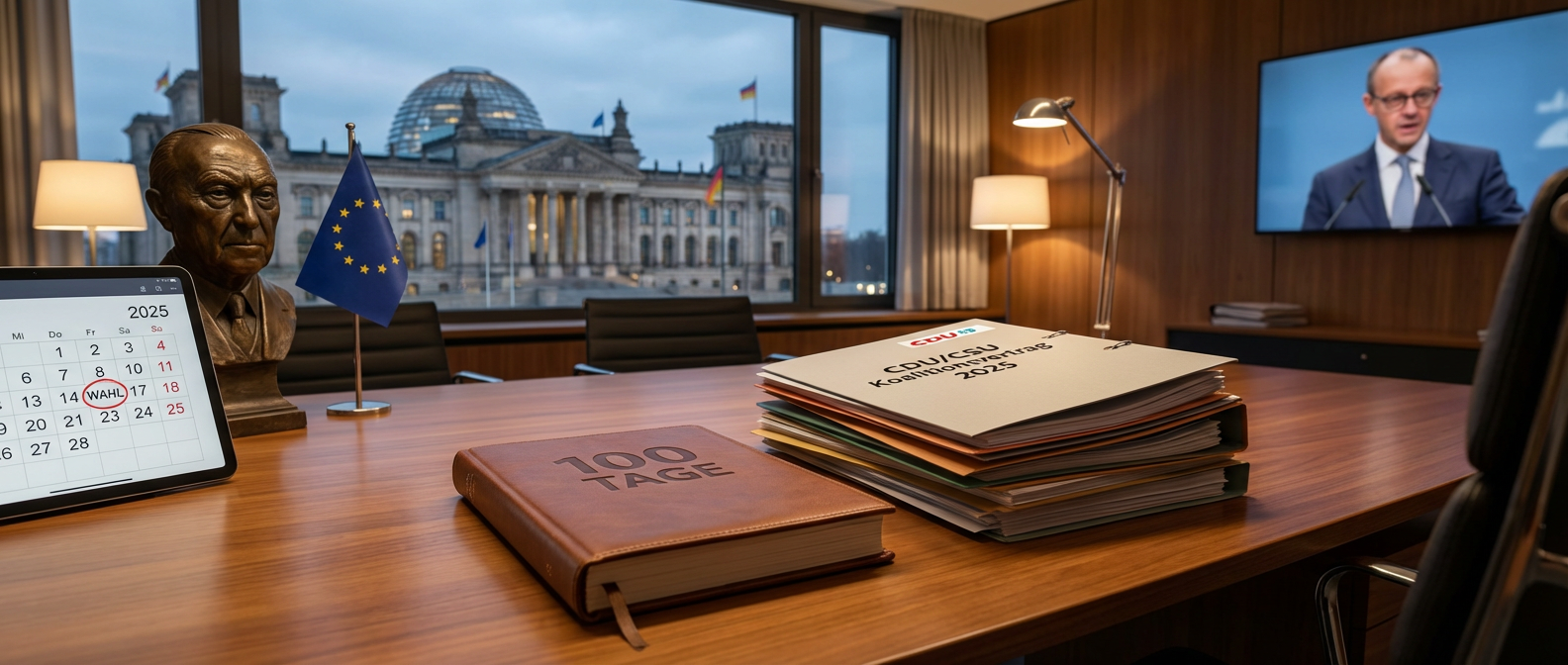
Merz's First Hundred Days: Why Germany's Election Verdict Matters More Than You Think
Merz’s First Hundred Days: Why Germany’s Election Verdict Matters More Than You Think

The real story lives in the second-place finish. The Alternative for Germany, the AfD, pulled roughly 20.8% of the vote. That number deserves your attention. It marks a historic high for the far-right party and represents a fundamental shift in Germany’s political grammar. When one in five German voters backs a party that mainstream parties refuse to work with, you are no longer discussing a temporary protest vote or fringe movement. You are discussing structural change in how Germans think about governance, immigration, and their place in Europe.

Merz’s coalition arithmetic became the real test. With the SPD, the CDU/CSU assembled a governing majority of 328 seats in the Bundestag by April 2025. On its surface, a grand coalition feels like stability. In reality, it constrained Merz’s ideological room for maneuver from day one. He would need to negotiate with a social democratic partner weakened by years of governing but still capable of blocking his preferred policies. This is the paradox of winning while fragmentation rises: your victory may grant you office but not freedom.

Illustration for Merz's First Hundred Days: Why Germany's Election Verdict Matters More Than You Think
Illustration for Merz’s First Hundred Days: Why Germany’s Election Verdict Matters More Than You Think

The Debt Brake Suspension: Necessity or Rupture?

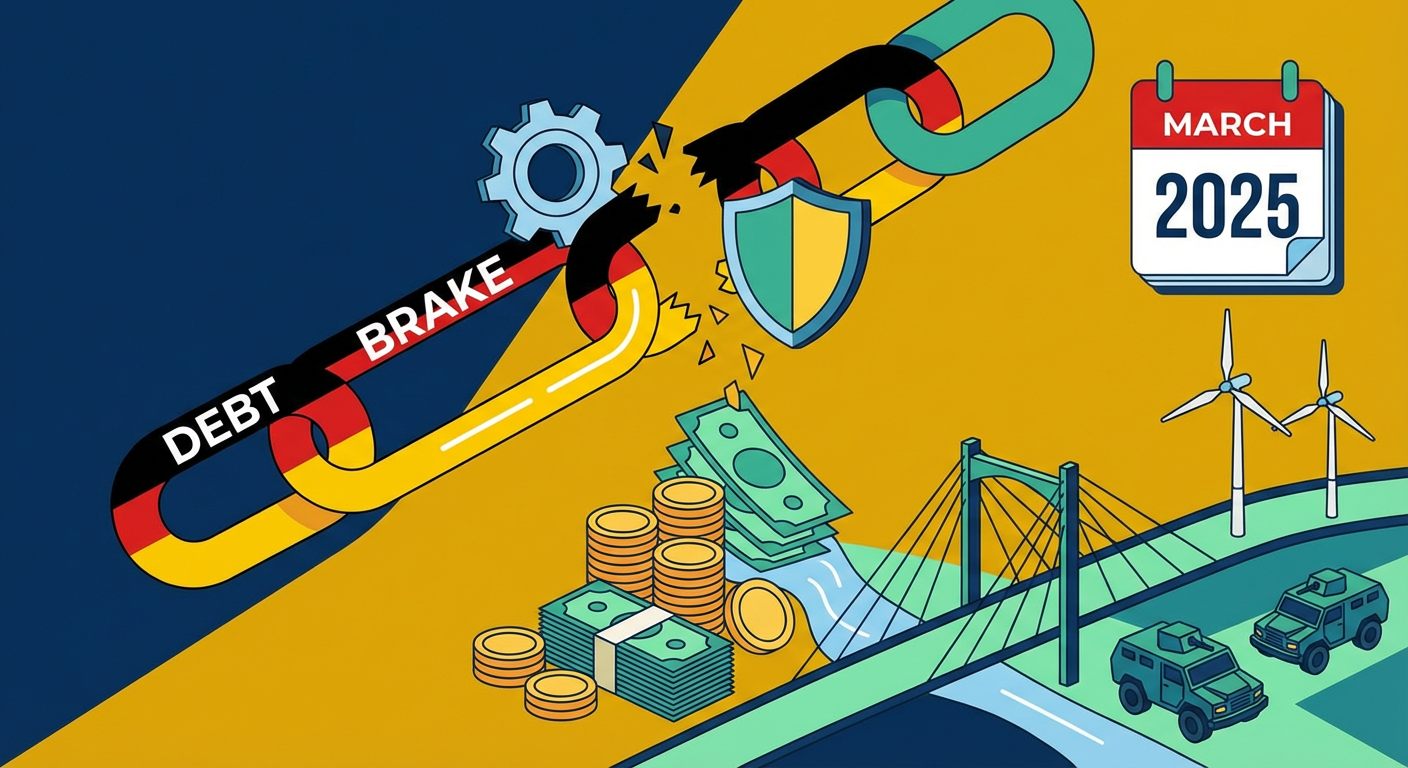
By March 2025, Merz’s government had already made a decision consequential enough to warrant a closer look. Germany’s constitutional debt brake, a provision so deeply embedded in German fiscal orthodoxy that it almost feels like natural law, was suspended. The purpose was clear: funding a €500 billion infrastructure and defense package that would reshape German economic and military capacity. You can examine Merz government’s €500 billion spending package — Deutsche Welle for the technical details, but the philosophical shift is what interests me here.

The debt brake itself dates to 2009, a response to the financial crisis that crystallized into German constitutional law in 2011. It represented something more than fiscal prudence. It embodied a particular vision of political responsibility: the idea that governments should not burden future generations with debt, that living within means was not just economically sound but morally necessary. This framework shaped German policy during the eurozone crisis, influenced German negotiating positions in Europe, and became central to German self-understanding as an economically disciplined nation.

Now Merz suspended it. The justification rested on a dual emergency: Ukrainian territorial integrity required military support, and German infrastructure required modernization after years of underinvestment. Both claims hold weight. Yet the suspension also signals something about how Merz reads the current moment. He appears to believe that the cost of maintaining fiscal orthodoxy exceeds the cost of breaking it. Reasonable people, including serious economists, disagree about whether this was prudent crisis management or the beginning of fiscal deterioration. What matters is that Merz chose to crack the foundation rather than work within it.

The Military Rearmament Question

The German military budget tells a revealing story about how profoundly the security environment has shifted. By 2027, Bundeswehr spending is on track to reach 3% of GDP. This exceeds NATO’s 2% benchmark and represents a real departure from decades of German strategic doctrine. Under Merkel, Germany consistently argued that military spending should be balanced against development aid, that hard power mattered less than soft power, that Germany’s economic strength was its contribution to alliance stability.

Merz is arguing differently. The invasion of Ukraine forced recalibration, certainly, but Merz has accelerated and deepened that recalibration beyond what pure reaction to events would require. This reflects a genuine strategic judgment: that Europe faces a long-term Russian threat, that American commitment cannot be assumed indefinitely, and that Germany must rebuild military capacity it dismantled or neglected. Whether this judgment proves correct will shape European security for a long time. What we can observe now is that Merz is betting on it and has structured German budgets accordingly.

This matters for European politics because Germany’s military posture constrains and enables everything else on the continent. A rearmed Germany reassures some allies and unsettles others, forcing recalculation in multiple capitals. Poland reads it as security commitment. France reads it with more ambivalence, watching whether German strength will translate into German influence. Russia reads it as confirmation of hostile encirclement, whether fairly or not. Merz’s hundred days included early signals that he intends Germany to play a more active role in European security architecture, not merely as wealthy paymaster but as a serious military power.

What Merz’s Coalition Signals About Center-Right Governance

The CDU/CSU-SPD coalition tells us something about European center-right politics in 2025. Merz governed with a subordinate partner despite holding the electoral upper hand. This differs markedly from the approach taken by right-leaning parties in Hungary, Poland, or Italy, where electoral victory translated into unconstrained executive power. Merz chose, or was forced to choose, the negotiated path. Interpret that generously and it suggests respect for institutional constraint. Interpret it less charitably and it suggests a center-right leader incapable of implementing his full agenda.

The question of German Europe matters here too. The grand coalition meant that Merz’s European vision had to be compatible with SPD social democrats who take a different view of EU integration, corporate taxation, and labor standards. His first hundred days included early EU negotiations where these tensions surfaced. The Merz government pushed for fiscal discipline and competitive market frameworks. The SPD pushed back toward social protection and coordinated European policy. Neither side won completely, which is how coalitions work, but it meant European neighbors faced a somewhat diluted and complicated German position rather than Merz’s undiluted philosophy.

This raises a genuine question about what center-right leadership means in a fragmented Europe. Merz commands a party that won decisively by recent standards. Yet constraints bind him at multiple levels: the AfD’s presence forces mainstream parties to reassure voters about democratic commitment, the fragmented parliament requires coalition, the SPD partner requires compromise, and NATO allies require consultation. Does this represent healthy institutional constraint or the erosion of executive capacity to implement mandates? His hundred days suggest a leader learning to navigate constraint rather than bulldoze through it. Whether that’s wisdom or weakness probably depends on which policy you’re watching.

The Lingering Uncertainties

What remains genuinely unsettled as we assess Merz’s early tenure? First, whether the AfD’s 20.8% represents a plateau or a floor. If German far-right support continues rising, mainstream party coalitions face narrower and narrower governing majorities. At some point the math forces uncomfortable choices. Second, whether Germany’s military rearmament proceeds as planned or faces public resistance as defense budgets squeeze social spending. Germans have never been enthusiastic about military spending, and €500 billion commitments inevitably invite political contestation.

Third, and perhaps most fundamentally, whether Merz’s approach to European leadership will add up to something coherent or fragment under the weight of competing pressures. His first hundred days sent mixed signals: firmness on Ukraine and NATO, caution on EU integration, pragmatism on fiscal matters. Whether this represents genuine strategic vision or tactical maneuver will only clarify over time. What I can say is that Merz inherited a Germany at an inflection point and chose to accelerate change rather than resist it.

You can examine Germany’s 2025 election results — Federal Returning Officer for the complete data if you want to verify claims about vote shares and seat distributions. What I am most curious about is your reading of these developments. Does Merz’s early governance suggest that center-right European parties can adapt to current conditions, or does