Project 2025 in Practice: What One Year of Executive Orders Actually Reveals About Institutional Change

The Scale Question: Why Raw Numbers Matter Less Than We Think

By January 2026, the Trump administration had issued over 140 executive orders in its first year. This figure demands context before it demands conclusions. The American Presidency Project executive order database confirms this exceeds any comparable first-year total since Franklin Roosevelt’s presidency. That comparison immediately complicates itself. FDR governed during national economic collapse and assumed office with Democratic supermajorities in both chambers. Trump inherited unified Republican control but faced a judiciary appointed largely by predecessors, a media ecosystem fractured in ways the 1930s never experienced, and federal institutions already staffed by prior administrations. The sheer count tells us something real: this presidency moved fast. But it doesn’t tell us what moved, how permanently, or at what constitutional cost.

The Heritage Foundation’s Project 2025 policy blueprint has functioned as something between a roadmap and a permission structure. At 900 pages, the Mandate for Leadership document represents the accumulated policy wishes of dozens of conservative organizations. ProPublica’s federal policy change tracker has documented at least 60 policy actions directly citing Project 2025 as basis or inspiration. Sixty out of 140 is roughly 43 percent. That suggests something more systematic than random executive action. It suggests an administration executing a pre-written agenda. But here’s where things become genuinely complicated: executing an agenda isn’t inherently authoritarian, illegal, or even unusual. Administrations always arrive with policy goals. What matters is whether those goals respect constitutional limits and institutional norms. Which means we need to examine not just that Project 2025 was implemented, but how.

The Personnel Question: Schedule F and the Architecture of Control

The Office of Personnel Management reported that approximately 24,000 federal employees were reclassified under Schedule F by mid-2025. This number deserves careful parsing. Schedule F reclassification strips civil service protections from career employees in policy-adjacent roles, enabling their replacement with political appointees. The Heritage Foundation explicitly advocated for this in Project 2025, arguing that career civil servants obstruct executive will. There’s a legitimate governing philosophy here: elected presidents should command executive branch loyalty, and entrenched bureaucrats do sometimes resist policy implementation. But the counterargument is equally serious. The civil service exists precisely to ensure that government functions like law enforcement, environmental protection, and tax collection operate according to law rather than political convenience. Twenty-four thousand reclassified employees is roughly eight percent of the executive branch workforce. Not total, but concentrated in policy-facing positions where political-legal boundaries matter most.

The real question is what actually changed after reclassification. Did Schedule F hires improve policy implementation or corrupt institutional integrity? The honest answer after one year is mixed and contested. Some agencies reported faster decision-making. Others reported mass resignations of experienced staff. The Merit Systems Protection Board received sharply elevated complaint filings. We lack sufficient distance to distinguish temporary disruption from permanent damage. What we can say is this: an administration can justify aggressive personnel action, but justification doesn’t eliminate risk. When 24,000 people lose their legal status simultaneously, risk scales.

The Judicial Pushback: What 90 Injunctions Actually Mean

Federal district courts issued over 90 nationwide injunctions against executive orders in the first 12 months. The Georgetown Law Center on Congressional Studies confirms this as the highest single-year count in modern judicial history. This statistic frightens some observers and emboldens others, depending on their priors about executive power. Conservative critics argue that judges are obstructing legitimate presidential action. Progressive critics argue that judges are doing exactly what they should: checking executive overreach. Both arguments contain truth. Courts do sometimes side with plaintiffs for ideological reasons. Courts also do sometimes halt policies that violate established law. The question isn’t whether 90 injunctions prove the administration violated constitutional limits. It proves that 90 times, judges believed constitutional violations plausible enough to warrant preliminary relief.

What matters more than the count is the pattern. Were injunctions concentrated in particular policy areas? Were they issued by judges from particular backgrounds? Were they reversed on appeal? The answers vary. Some injunctions addressed obvious standing problems. Others targeted substantive policy disagreements dressed up as legal claims. Still others rested on serious interpretations of statutory authority. The point worth sitting with is this: if an administration’s executive orders generate historically unprecedented judicial resistance within twelve months, something material is occurring. It might be inappropriate judicial activism. It might be genuine legal overreach. It almost certainly involves both, in proportions we’ll argue about for years. But the scale of resistance is itself data. It suggests either that the administration is governing radically differently from predecessors, or that courts are responding to that governance radically differently. Either way, institutional equilibrium shifted.

The Public Reckoning: Approval, Concern, and the Partisan Divide

A January 2026 Gallup poll recorded presidential approval at 44 percent, with 61 percent of independents expressing concern about the pace of changes to federal institutions. These numbers are worth breaking apart. Among Republicans, approval exceeded 85 percent. Among Democrats, it stood below 10 percent. The interesting figure is independents. Three-fifths expressed concern about institutional change pace. Concern doesn’t equal disapproval exactly. It suggests unease, people watching and finding something disorienting in how quickly federal structures shifted. Partisan polarization means presidential popularity now tracks partisan identity more reliably than policy effectiveness. But independents occupy a different position. They lack strong team identity. When they register concern, they’re often noticing something real about governance rather than filtering approval through party loyalty.

The 44 percent overall approval is neither historically low for an incumbent nor particularly robust. It reflects a presidency with intense support and intense opposition, minimal persuadable middle. Whether that’s good or bad depends on your constitutional theory. If you believe majorities should decisively govern, then polarization with majority support justifies ambitious action. If you believe minorities deserve protection and consensus-building strengthens institutions, then polarization without middle-ground accommodation threatens stability. The Gallup data doesn’t resolve this argument. It documents that argument’s reality. After one year of Project 2025 implementation, the public remained divided on whether institutional transformation was necessary and whether its pace was prudent.

Provisional Judgment: What the Evidence Actually Supports

Here’s what one year of evidence establishes with reasonable confidence: the Trump administration implemented Project 2025 selectively but seriously. It issued historically high volumes of executive orders. It reclassified thousands of career employees. It encountered historically high volumes of judicial resistance. And it maintained strong support among Republicans while concerning a majority of independents. These are facts. Interpreting them requires intellectual honesty about complexity. The administration can argue it received a mandate to govern decisively and that Project 2025 represented carefully considered conservative policy. That’s defensible. Opposition can counter that rapid institutional restructuring, concentrated executive power, and reduction of career-service protections threaten constitutional governance. That’s also defensible. Both arguments contain legitimate concerns.

What I think the evidence actually shows is this: the second Trump administration governed more systematically according to a pre-written policy blueprint than recent predecessors, deployed more aggressive personnel authority, and encountered more sustained judicial resistance as a result. Whether that represents good governance or something genuinely worrying depends partly on policy outcomes we can’t fully evaluate yet. It also depends on constitutional theory where reasonable people disagree. But it represents something different from what came before. Whether different proves better or worse is the actual question, and it’s one requiring ongoing attention rather than premature closure. What’s your reading of the evidence? How are you weighing institutional change against policy implementation in your own judgment?


Germany’s New Security Posture: What the Merz Coalition Means Beyond Berlin

The February Election Scrambled German Politics in Ways We’re Still Decoding

Friedrich Merz’s CDU/CSU won roughly 28.5 percent of the vote on February 23, 2025. Stop there for a moment. That sounds decisive until you remember that Germany’s electoral system demands coalition mathematics, and 28.5 percent in Berlin translates to genuine constraint, not mandate. The party that dominated German politics for sixteen years under Angela Merkel returned to power, but on fundamentally different terms. This wasn’t a restoration. It was a reorientation forced by circumstances the CDU did not create alone.

Germany's New Security Posture: What the Merz Coalition Means Beyond Berlin
Germany’s New Security Posture: What the Merz Coalition Means Beyond Berlin

The real shock was the second-place finish. The AfD took 20.8 percent, its strongest federal performance in history. That’s not hyperbole. That’s a structural break in the German party system. When a party with roots in far-right movements captures one-fifth of the national vote, the entire political context shifts, regardless of how many other parties refuse to work with it. Every coalition decision the Merz government makes now happens in the shadow of that result. Every budget line, every security commitment, every foreign policy statement carries weight it wouldn’t have in a normal election cycle.

The Social Democrats Disappeared. That Matters More Than You Think.

Olaf Scholz’s SPD collapsed to 16.4 percent. The worst federal result since 1945. Let that anchor you to what actually happened here. The party that led the German government just four months earlier, that claimed to represent working-class interests and stability, essentially lost its claim to either. In the previous coalition model, the SPD held meaningful leverage. They could extract concessions, shape cabinet composition, defend their constituency priorities within governing arrangements.

That leverage evaporated. When Merz negotiated his coalition agreement, the SPD sat outside the conversation entirely. The Greens and FDP became more relevant coalition partners than Germany’s historic social democratic party. This has real consequences for security policy. It means Merz faced fewer internal coalition pressures resisting expanded defense spending. The constituencies traditionally skeptical of military expansion now have weaker parliamentary representation. The new government’s security architecture developed without having to accommodate the party that most explicitly campaigned on restraint and dialogue with Russia.

Defense Spending Became the Coalition’s Central Battleground

Germany’s constitutional debt brake, the Schuldenbremse, had been considered nearly untouchable for years. It restricts government borrowing to 0.35 percent of GDP, except during emergencies. Merz’s government arrived proposing over 100 billion euros in new spending for defense and infrastructure. Translation: the new government immediately signaled it would frame defense expansion as a constitutional emergency. That’s a decision with European implications.

The debate wasn’t really whether Germany should spend more on defense. NATO’s 2 percent GDP target had become baseline expectation across the alliance. Merz signaled openness to 3 percent, which means roughly 120 billion euros annually, a figure that dwarfs anything Germany committed during the Scholz years. The real argument was about mechanism. How do you mobilize that spending while respecting constitutional constraints? Do you invoke emergency provisions? Do you restructure budgetary categories? Do you temporarily suspend the debt brake?

These sound like technical questions. They’re actually about political philosophy, about what Germany considers legitimate grounds for breaking its own fiscal rules. About whether European security counts as sufficient emergency to override constitutional guardrails written precisely to prevent the kind of deficit spending that destabilized the eurozone a decade ago. Merz’s answer differed from his predecessors’. He was willing to treat security threat as constitutional moment.

What This Means for European Security Architecture

Germany under Merz has signaled a security posture distinct from the Merkel-Scholz era in both scale and rhetoric. Merkel managed Germany’s security commitments through careful diplomatic language and alliance consensus-building. Scholz inherited the Russian invasion of Ukraine and grudgingly expanded defense spending while maintaining rhetorical caution about escalation. Merz arrived with a different read entirely: Germany should lead European security rather than follow consensus.

The 3 percent defense spending proposal makes this concrete. France spends roughly 1.9 percent. Italy roughly 1.5 percent. Most European NATO members remain below 2 percent. Germany at 3 percent becomes a defense outlier, investing at levels comparable to Poland or the Baltic states rather than its Western European peers. That’s a deliberate choice about role and identity. It says Germany will be a security provider rather than a security consumer. It signals willingness to bear a disproportionate burden in European deterrence.

The coalition agreement also reflected this shift in NATO positioning. The new government prioritized industrial defense production capacity, long-term procurement commitments, and joint European weapons development. These aren’t symbolic gestures. They’re investments that lock Germany into a security posture for years. German defense contractors will expand. German military spending becomes a structural feature of budget planning rather than a temporary response to crisis.

The Constraint Nobody’s Talking About Explicitly

Here’s what makes this genuinely complicated: Merz’s security ambitions require coalition partners with their own domestic pressures. The Greens have constituencies skeptical of rearmament. The FDP has fiscal conservatives nervous about debt. The AfD’s 20.8 percent sits outside the coalition but can’t be ignored. Every coalition decision happens with awareness that a significant portion of the electorate opposes the government’s entire direction.

The Federal Returning Officer Official Results tell one story. The political negotiations after those results tell another. Merz had to construct a majority coalition from parties that disagreed on security spending, fiscal policy, and European integration. The security architecture that emerged reflects those compromises. It’s bolder than Scholz would have pursued. It’s probably more cautious than Merz personally preferred. That’s coalition governance.

For European partners, this matters because German security commitments now come with domestic fragility built in. The AfD’s growth means electoral volatility will likely continue. German coalitions will probably remain complicated. Policy reversals become possible if coalition dynamics shift. This doesn’t make German security commitments worthless. It means they require ongoing validation through performance and results. Germany can’t commit and assume consensus will hold.

Where This Leaves Us

The Merz government represents a genuine shift in German security posture, but it’s constrained by coalition mathematics, constitutional requirements, and electoral fragmentation. Germany will likely spend more on defense. It will probably deepen security partnerships with Poland and the Baltic states, probably strengthen NATO’s eastern flank. But these commitments will develop through tight budget negotiations and coalition compromises, and they’ll remain vulnerable to electoral shifts.

The European Council on Foreign Relations Germany Analysis captures some of this complexity in real time. What specific aspects of German security policy under Merz interest you most? The industrial production questions? The NATO integration details? The domestic coalition pressure points? Worth thinking through, because how Germany shapes its role shapes how Europe responds to its security environment more broadly.

The War Cabinet’s End and Israel’s Fractured Future: Why 2025 Marks a Strategic Inflection Point

The Coalition Unravels: More Than Political Theater

When Benny Gantz walked out of Israel’s emergency war coalition in June 2024, most observers treated it as a routine political crisis. Another coalition collapse, another round of recriminations. But Gantz’s departure wasn’t just disagreement over reconstruction policy or complaints about decision-making speed. It signaled a structural realignment that would reshape Israeli politics for years to come. His National Unity Party had given Netanyahu a moderate veneer, a way to claim cross-partisan support for the Gaza operation. Without it, Netanyahu faced a very different political reality.

The War Cabinet's End and Israel's Fractured Future: Why 2025 Marks a Strategic Inflection Point
The War Cabinet’s End and Israel’s Fractured Future: Why 2025 Marks a Strategic Inflection Point

The numbers tell the story. Polling through late 2025 consistently showed Netanyahu’s Likud commanding fewer than 20 seats in a hypothetical 120-seat Knesset election — a dramatic decline from historical baselines. For a prime minister who has always navigated Israeli politics through coalition arithmetic, that’s a catastrophic trajectory. The war that was supposed to vindicate his leadership instead hollowed out his political foundation. Gantz’s exit wasn’t the cause of this collapse. It was a symptom.

Illustration for The War Cabinet's End and Israel's Fractured Future: Why 2025 Marks a Strategic Inflection Point
Illustration for The War Cabinet’s End and Israel’s Fractured Future: Why 2025 Marks a Strategic Inflection Point

The Ceasefire Paradox: Victory and Vulnerability

The January 2025 Gaza ceasefire brokered by Qatar, Egypt, and the United States looked like a diplomatic achievement on paper. Phase 1 included a carefully negotiated exchange: 33 Israeli hostages released in return for approximately 1,900 Palestinian prisoners held in Israeli facilities. For hostage families, this was vindication. For Netanyahu, it was something considerably more dangerous.

A ceasefire halts active warfare. But Netanyahu’s political survival had depended on the necessity of continued military operations. The longer the war ran, the more his right-wing coalition partners needed him. The moment a ceasefire took hold, that dependency evaporated. His partners in the far-right Religious Zionism bloc and Otzma Yehudit suddenly faced a choice: keep supporting a weakened prime minister or start positioning themselves for the opposition. Many chose the latter. The ceasefire didn’t end Netanyahu’s problems. It accelerated them.

The ICC Warrant and the International Dimension

In November 2024, the International Criminal Court issued arrest warrants for Netanyahu and former Defense Minister Yoav Gallant. The charges were severe, including allegations of using starvation as a method of warfare in Gaza. A sitting prime minister facing international arrest warrants while still in office is extraordinarily rare in modern democracies, and the implications spread across multiple domains at once.

Diplomatically, the warrant creates complications across all 27 ICC member states. Netanyahu cannot freely travel to much of Europe. Coalition partners worried about Israel’s international standing start calculating whether association with an indicted leader damages their own political futures. The warrant doesn’t prove guilt, but it creates a permanent cloud of legal jeopardy. More quietly, it makes Netanyahu a potential liability for any coalition partner already thinking about their post-Netanyahu career. For further context on the international legal dimensions, see the International Criminal Court: Situation in the State of Palestine.

The Humanitarian Catastrophe as Political Liability

By January 2025, Gaza’s humanitarian situation had deteriorated into what the UN classified as Category 5 famine conditions across the northern governorates. The population of approximately 2.1 million faced near-complete collapse of food distribution infrastructure according to the UN World Food Programme. These weren’t abstract statistics. They were images broadcast globally, images that Israeli voters saw alongside footage of their own relatives still held hostage.

This presented Netanyahu with an impossible bind. Continuing the war meant escalating humanitarian devastation. Ending it meant losing the justification for emergency measures that kept his coalition intact. The ceasefire attempted to thread this needle but satisfied neither the humanitarian imperative nor the political hard-liners. Israeli voters increasingly faced a choice between supporting continued operations that perpetuated civilian suffering or demanding a different approach entirely. For detailed humanitarian data, consult the UN OCHA: Humanitarian Situation Update — Gaza. Neither option strengthened Netanyahu’s position.

The Fiscal Reckoning and Strategic Recalibration

The war’s economic cost imposed constraints that political rhetoric couldn’t talk away. Israel’s Central Bureau of Statistics reported in late 2025 that direct war costs exceeded 200 billion New Israeli Shekels, roughly $55 billion USD. The fiscal deficit hit 8.1% of GDP in 2024, the highest since 2002. For a country accustomed to fiscal discipline and security-conscious budgeting, those numbers represent a genuine shock.

Fiscal crises concentrate political minds. When citizens face deteriorating public services, a struggling healthcare system, and eroding living standards because of war costs, they start asking harder questions about that war’s necessity and trajectory. The economic burden transformed Gaza from an abstract strategic question into a tangible cost borne by Israeli households. Netanyahu could argue the war was necessary. He couldn’t argue that indefinite continuation was economically sustainable. Military stalemate, diplomatic constraints, and fiscal exhaustion together created real pressure for strategic recalibration.

The Emerging Landscape and Unanswered Questions

Looking into 2025 and 2026, Israeli politics faces a structural realignment with no clear resolution in sight. Netanyahu’s war cabinet has collapsed not through formal dissolution but through the exit of its moderate elements and the slow erosion of its coalition. The prime minister remains in office, but his political foundation keeps shrinking. The ceasefire prevents immediate crisis without resolving the deeper contradictions about Israel’s long-term strategy in Gaza and the Palestinian territories.

The real question isn’t whether Netanyahu survives another election. It’s whether any coherent political coalition can emerge from the current fragmentation with a clear mandate for post-war strategy. Will Israel’s next government pursue aggressive reconstruction of security frameworks in Gaza? Seek negotiated settlements? Attempt permanent occupation? These questions are genuinely open. The war cabinet’s collapse has created a vacuum, not an answer.

What aspects of this analysis challenge your own read of Israeli politics? Where do you see these dynamics taking the country? Military reality, diplomatic constraint, and domestic politics rarely produce neat conclusions when they collide. I’m curious how readers are thinking through these competing pressures.

Project 2025 in Practice: Tracking Which Policy Proposals Actually Became Law 12 Months In

The Measurement Problem Nobody Wants to Discuss

Before we can meaningfully answer which Project 2025 proposals became law, we need to reckon with a methodological problem that makes simple scorecards misleading. The Heritage Foundation’s Mandate for Leadership document sprawled across 920 pages and outlined restructuring across 436 federal programs and agencies. That’s not a policy agenda. That’s a taxonomy of the entire federal government with editorial commentary. When we ask “how many became law,” we’re actually asking several different questions at once, and they have wildly different answers.

Project 2025 in Practice: Tracking Which Policy Proposals Actually Became Law 12 Months In

Some Project 2025 recommendations required congressional action. Some needed only executive orders. Some involved reinterpreting existing law. Some called for administrative actions that fall into a legal gray zone. A Department of Education elimination needs legislation. A freeze on diversity hiring needs an executive order and agency reinterpretation. A shift in tax enforcement priorities needs neither. Lumping these together into a single “implementation percentage” obscures more than it reveals.

This matters because it determines whether we’re assessing the agenda’s actual influence or merely its ability to harness existing presidential power. The distinction isn’t pedantic. It goes to the heart of how we should evaluate executive activism, democratic accountability, and what “implementing an agenda” even means in a constitutional system with separation of powers.

Illustration for Project 2025 in Practice: Tracking Which Policy Proposals Actually Became Law 12 Months In

What Got Done: The 60-65 Percent Figure and What It Actually Means

By early 2026, roughly 60 to 65 percent of Project 2025’s first-year recommendations had either been implemented or initiated in implementation, according to tracking by The Washington Post. That sounds comprehensive until you unpack what “initiated” means. It means the administration started the process, filed the regulatory notice, signed the executive order, or announced the shift in enforcement priorities. Completion and implementation are different animals.

The low-hanging fruit came first. In the first 100 days alone, the Trump administration signed executive orders that directly mirrored Project 2025 language on DEI program elimination. These orders touched over 400 federal offices. That’s real implementation, executed quickly through executive authority. No congressional negotiation required. No lawsuit could stop it in the moment. The diversity infrastructure built across decades of Democratic and Republican administrations got dismantled in weeks.

But here’s where the narrative gets complicated. Those early wins were concentrated in areas where the president already possessed clear authority. The remaining 35 to 40 percent includes items requiring congressional passage, facing legal challenges, or stuck in regulatory proceedings. Check the Washington Post Project 2025 Policy Tracker and you’ll see this distinction clearly marked. The items labeled “pending congressional action” or “facing legal challenge” are where the rubber meets the road for assessing genuine influence versus executive theater.

The Legislative Roadblock: Congress as Constraint

The Department of Education abolition is the clearest example of legislative constraint. Eliminating an entire cabinet department requires an act of Congress. Project 2025 made this recommendation. The administration clearly wanted it done. But here we are, over a year in, and the department still exists. That’s not because the Trump administration lacked commitment. It’s because you can’t write an executive order firing 4,000 employees and transferring billions in annual spending to other agencies. The Constitution won’t permit it. Congress must act, and Congress has competing priorities, internal disagreements, and members who represent districts that depend on federal education spending.

This is where Project 2025 meets democratic reality. Many recommendations were highly specific about federal program restructuring and interagency coordination. These require legislative cooperation. The administration can use executive authority to shift how agencies operate within existing law, but transforming the structure of government itself demands a different mechanism. The Heritage Foundation’s architects understood this intellectually. But they produced a document that implied most items could be accomplished in the first term. Some can be. Many cannot.

The congressional dynamics matter here too. Even with Republican majorities, legislative bandwidth is finite. Priorities compete. Some Republicans represent districts where federal programs matter economically. Others face pressure from constituencies dependent on specific agencies. Project 2025 assumed a level of party discipline and unified purpose that rarely materializes in practice. The gap between what a movement wants and what a governing coalition can deliver is where ideology collides with the actual mechanics of democracy.

Public Awareness and Political Salience: The Unexpected Shift

Something interesting happened to Project 2025 in the public consciousness. In mid-2024, only 25 percent of Americans had heard of it. By late 2025, that number had climbed to 61 percent, according to Pew Research Center data. That’s a dramatic shift in political salience. Project 2025 went from insider document to something a substantial majority of Americans could identify.

But here’s the problem: increased public awareness didn’t necessarily increase public support for the agenda. Pew Research Center Political Survey Data shows that awareness grew substantially independent of approval. Many Americans who learned about Project 2025 learned about specific proposals through opposition messaging, not supportive framing. The document’s comprehensiveness, which made it influential inside conservative circles, made it vulnerable to selective quotation outside them. Heritage Foundation staff could point to serious policy analysis. Critics could point to passages that sounded extreme when removed from context.

This matters for understanding implementation success. Some Project 2025 recommendations faced public backlash that constrained executive action. Others faced backlash that Congress felt acutely. The political cost of certain proposals changed as public awareness increased. That’s not a failure of implementation. It’s how representative democracy should work. The agenda met friction not just from institutional design but from public opinion. Whether you view that as an obstacle or a feature likely depends on your politics.

The Honest Assessment: Implementation Without Transformation

The 60 to 65 percent implementation rate tells us that the Trump administration successfully executed the elements of Project 2025 that fall within executive authority. DEI elimination happened. Regulatory review happened. Agency restructuring within legal bounds happened. That’s substantial. It’s also exactly what we should expect when a newly elected president has a clear policy document aligned with his priorities and enjoys GOP congressional majorities.

But it doesn’t constitute a comprehensive restructuring of the federal government. The architecture remains mostly intact. The number of agencies is unchanged. The major cabinet departments still exist. The underlying statutory structure of federal spending and authority hasn’t been fundamentally altered. Project 2025 presented itself as transformational. In implementation, it looks more like significant reorientation within existing frameworks.

This raises a question worth sitting with: Was Project 2025 intended as a realistic policy agenda for a single term, or as an aspirational manifesto that acknowledged but didn’t emphasize the difference between what an administration might want and what it could actually accomplish? The honest answer is probably both. Heritage Foundation staff knew the difference between executive and legislative power. They produced a document anyway that implied most items were achievable. That’s either candor in tension or strategic ambiguity, depending on your interpretation.

The public reckoning with Project 2025 is still unfolding. Twelve months in, we can say with confidence that roughly two-thirds of first-year recommendations have been advanced, mostly through areas where presidential power is clearest. We can also say that the remaining third reveals the actual constraints on executive action in a system designed to disperse power. What remains unclear is whether this rate of implementation will sustain, whether public opinion will shift further as impacts accumulate, or whether the legislative items will gain traction in a second congressional term. Those are the questions that will ultimately determine whether Project 2025 represented a governing philosophy or an ambitious wish list. What’s your read on where this goes from here?

Why the 2030 Census Fight Is Actually About Your Power as a Young Voter

The Census Isn’t Just a Headcount. It’s a Redistribution Machine.

Every ten years, the United States conducts a constitutionally mandated headcount. On its surface, it sounds bureaucratic and quaint: knock on doors, count people, move on. But the Census is the mechanism by which political power gets redistributed across the country. The numbers that Census takers collect determine how many House seats each state receives. They determine how federal funding for education, infrastructure, healthcare, and social programs gets allocated across 435 congressional districts and thousands of local jurisdictions. They shape redistricting maps that determine who has electoral power for the next decade. The Census is not a neutral administrative exercise. It is a profound political act with real consequences for whose interests get represented and whose communities receive resources.

Why the 2030 Census Fight Is Actually About Your Power as a Young Voter

The 2030 Census is currently in the planning phase, and what happens over the next two years will matter enormously. The stakes are not abstract. Right now, decisions about methodology, staffing, and budget are being made that will determine whether your community is counted accurately or undercounted. These decisions will determine whether your state gains or loses political representation. They will determine whether your neighborhood receives the federal funding it needs for schools, roads, and public health. And because younger voters—Millennials and Gen Z—are concentrated in patterns quite different from previous generations, the accuracy and fairness of the 2030 Census will directly affect your age cohort’s political power relative to older Americans.

Illustration for Why the 2030 Census Fight Is Actually About Your Power as a Young Voter

The Staffing Crisis Is Already Here

Start with the immediate crisis: staffing. The Census Bureau received a congressionally approved budget of $16.8 billion for the 2030 decennial census. That sounds substantial until you understand the context. In early 2025, efficiency reviews related to broader federal restructuring placed roughly 800 Census Bureau positions under evaluation for potential elimination. These are not administrative positions in some distant headquarters. These are the actual people who train enumerators, manage quality control, oversee data processing, and ensure that hard-to-count populations actually get counted. Cut that many people while attempting to conduct the most ambitious enumeration in a decade, and you’ve built in structural vulnerability from the start.

Why does this matter to you? Because historically, undercounts are not random. They concentrate among specific populations: low-income people, communities of color, recent immigrants, people experiencing homelessness. The Census Bureau has been transparent about this reality. When you reduce staffing, you reduce your ability to conduct follow-up enumeration in hard-to-reach areas. Quality control suffers. Undercounts become more likely. And if young adults—particularly low-income young adults and young adults of color—are disproportionately undercounted, that has direct consequences for your generation’s political representation and your communities’ access to federal resources.

The Reapportionment Numbers Are Already Shifting

The Census doesn’t just determine funding distribution. It determines representation. After every decennial census, the 435 House seats are reapportioned among the 50 states based on population changes. Demographers at the Brookings Institution: Apportionment and Redistricting Projections have already published projections based on population trends and migration data. Their analysis suggests that the 2030 Census will shift political power in patterns that break down along age and demographic lines.

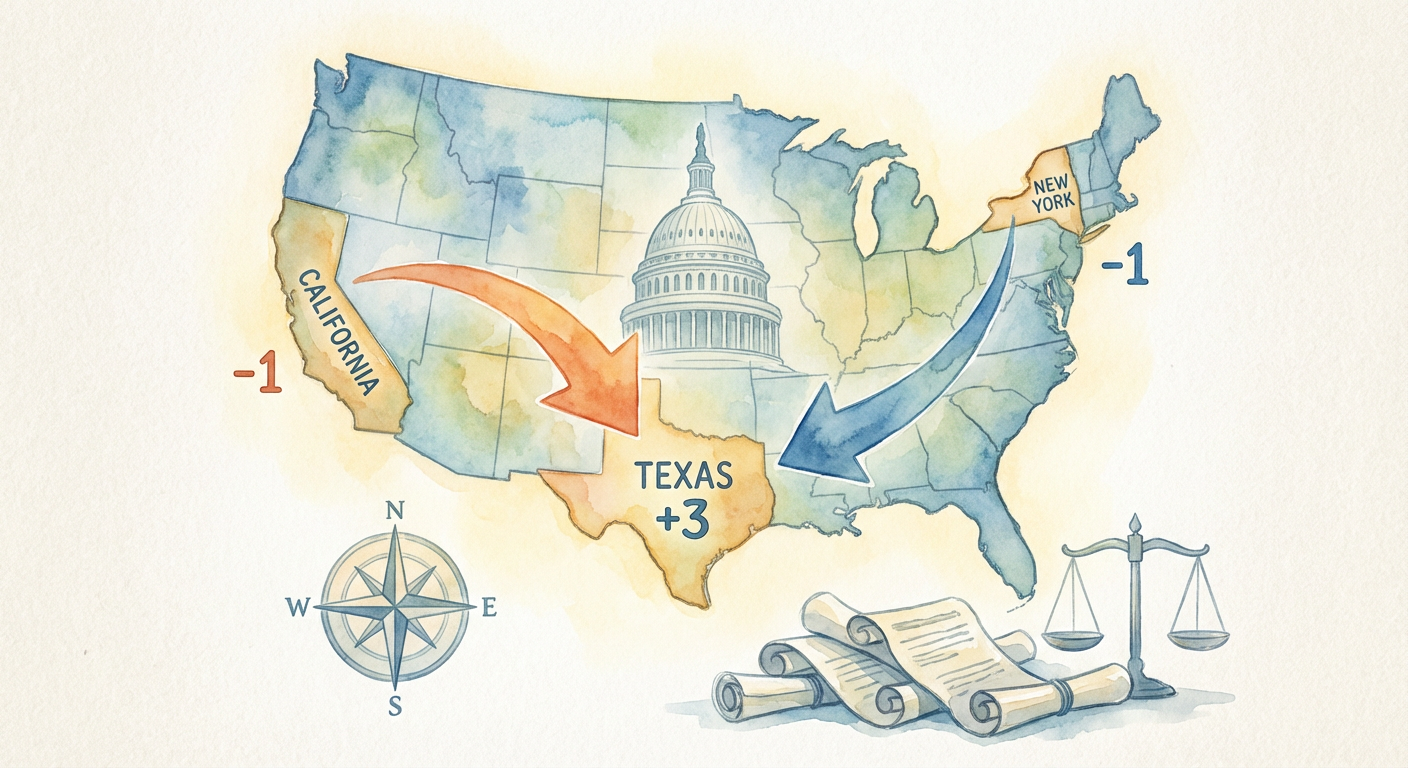
Texas is projected to gain three House seats. California and New York are each projected to lose one. Why? Population migration. People are moving south and west. But here’s where it gets interesting: the 2025 American Community Survey data from the Census Bureau shows that for the first time in American history, adults aged 18 to 34 outnumber Baby Boomers in 31 of the 50 states. This is an extraordinary demographic shift. In nearly two-thirds of the country, young voters are numerically dominant. But that dominance only translates into actual political power if they are accurately counted in the Census, and if that count accurately shapes redistricting maps. If you live in a state losing House seats because of undercounting in areas with high concentrations of young voters, your generation’s political weight gets physically removed from Congress.

The Money Follows the Numbers

Here is where the financial stakes become concrete. The Census determines not just representation but resources. Federal formula funding for education, infrastructure, Medicaid, housing assistance, and dozens of other programs is allocated based on Census population counts. A 2025 Urban Institute analysis found that a one percent undercount of low-income populations in the 2030 Census would result in approximately $1,800 per person annually in reduced federal formula funding flowing to those communities over the following decade. That is not a rounding error. For a low-income community with a population of 100,000, a one percent undercount means $180 million in cumulative funding losses over ten years. Schools get fewer resources. Public health programs get cut. Transportation infrastructure gets deferred.

Now connect this back to your generation’s lived experience. Young adults are more likely to live in rental housing, less likely to own homes outright, more likely to be geographically mobile. They are more difficult to reach through traditional enumeration methods. More likely to be missed in a census that relies on mail-back forms and limited follow-up. And because young adults are disproportionately concentrated in lower-income brackets compared to older age cohorts, undercounting of young adults directly reduces federal resources flowing to the communities where young people actually live.

The Methodology Question That Will Define Everything

This is where things get complicated. In late 2025, the Census Bureau announced a pilot program for new digital-first enumeration methods to be tested in 12 counties across five states ahead of the 2030 count. This is the most significant methodology test since the 2010 Census. What does that mean in practical terms? The 2020 Census relied heavily on mail-back forms, with follow-up visits for non-responses. The new methodology prioritizes online completion of census forms, using targeted digital outreach to identify and count hard-to-reach populations. On its face, this sounds sensible. Digital-first methods are potentially more efficient and cost-effective. But they also introduce new vulnerabilities. Visit the U.S. Census Bureau: 2030 Census Planning website and you will see the official parameters. Then ask yourself: who is most likely to respond to a digital-first enumeration? The answer is straightforward. People with reliable broadband access. People with devices. People comfortable conducting government transactions online. Not everyone fits that profile.

Young adults, statistically speaking, should have advantages in digital-first enumeration. You are the most connected generation. But young adults experiencing homelessness, young adults in rural areas with poor broadband infrastructure, young adults in institutional settings—none of them benefit from this shift. If the methodology pilot in 12 counties reveals that digital-first methods increase response rates among connected young professionals while decreasing response rates among young people in precarious circumstances, then the 2030 Census will have chosen a methodology that selectively undercounts the most vulnerable members of your generation.

What You Actually Need to Know Right Now

Three things. First, the decisions being made about Census staffing, methodology, and budget are not locked in. They can be influenced. Your state representatives and senators can pressure the Census Bureau for adequate staffing and transparent testing of new methodologies. Your communities can prepare to engage in enumeration outreach. You can demand accountability. Second, the 2030 Census will directly determine your generation’s political representation and your communities’ access to federal resources for the next decade. The connection is mechanical and direct. Third, you have a window of time to pay attention. By 2027, the methodology will be set. By 2028, the actual enumeration process will begin. If you wait until then to care about Census accuracy, you have missed your chance to shape the outcome.

What specific aspects of the 2030 Census concern you most? Which communities do you think are most likely to be undercounted? I want to hear your thoughts.