The Election Nobody Quite Expected
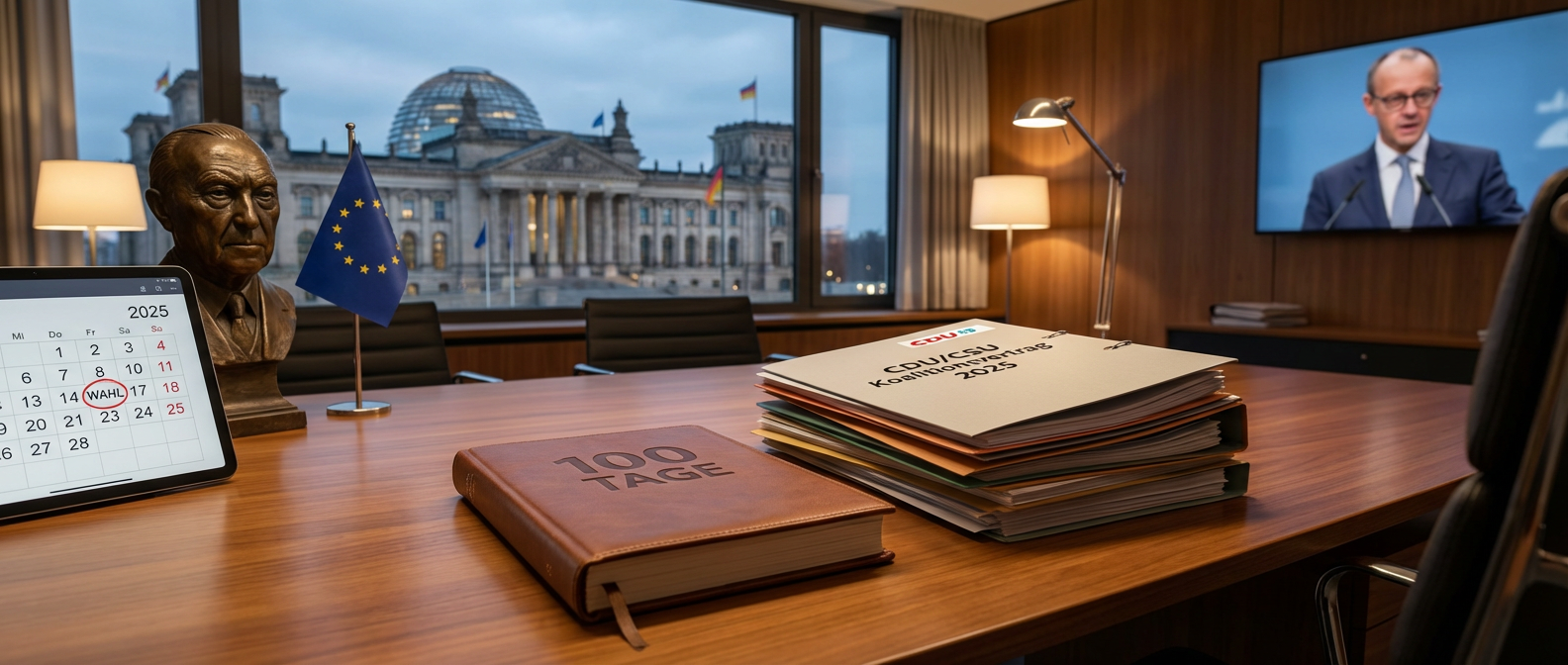
Friedrich Merz arrived at the chancellery in March 2025 with a mandate that looked cleaner on paper than it felt in practice. The CDU/CSU secured roughly 28.5% of the vote on February 23, capturing what seemed like a decisive victory. Yet here sits the first complication: this represented the party’s strongest performance in over a decade, which sounds impressive until you remember that Angela Merkel’s CDU regularly posted results above 33%. The comparison matters because it tells us something about the current German political landscape. Merz inherited a center-right party that has consolidated support, yes, but within a considerably fractured electorate.
The real story lives in the second-place finish. The Alternative for Germany, the AfD, pulled roughly 20.8% of the vote. That number deserves your attention. It marks a historic high for the far-right party and represents a fundamental shift in Germany’s political grammar. When one in five German voters backs a party that mainstream parties refuse to work with, you are no longer discussing a temporary protest vote or fringe movement. You are discussing structural change in how Germans think about governance, immigration, and their place in Europe.
Merz’s coalition arithmetic became the real test. With the SPD, the CDU/CSU assembled a governing majority of 328 seats in the Bundestag by April 2025. On its surface, a grand coalition feels like stability. In reality, it constrained Merz’s ideological room for maneuver from day one. He would need to negotiate with a social democratic partner weakened by years of governing but still capable of blocking his preferred policies. This is the paradox of winning while fragmentation rises: your victory may grant you office but not freedom.
The Debt Brake Suspension: Necessity or Rupture?
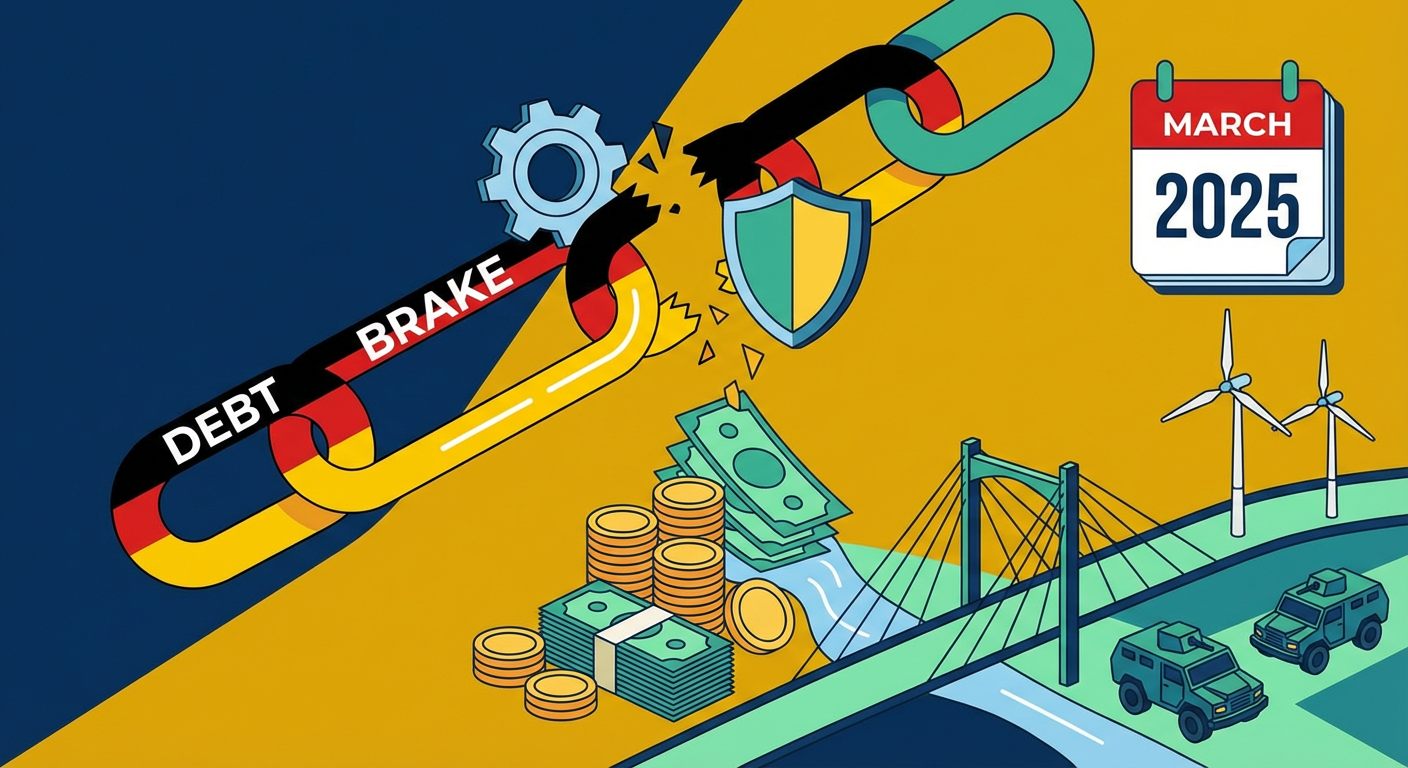
By March 2025, Merz’s government had already made a decision consequential enough to warrant a closer look. Germany’s constitutional debt brake, a provision so deeply embedded in German fiscal orthodoxy that it almost feels like natural law, was suspended. The purpose was clear: funding a €500 billion infrastructure and defense package that would reshape German economic and military capacity. You can examine Merz government’s €500 billion spending package — Deutsche Welle for the technical details, but the philosophical shift is what interests me here.
The debt brake itself dates to 2009, a response to the financial crisis that crystallized into German constitutional law in 2011. It represented something more than fiscal prudence. It embodied a particular vision of political responsibility: the idea that governments should not burden future generations with debt, that living within means was not just economically sound but morally necessary. This framework shaped German policy during the eurozone crisis, influenced German negotiating positions in Europe, and became central to German self-understanding as an economically disciplined nation.
Now Merz suspended it. The justification rested on a dual emergency: Ukrainian territorial integrity required military support, and German infrastructure required modernization after years of underinvestment. Both claims hold weight. Yet the suspension also signals something about how Merz reads the current moment. He appears to believe that the cost of maintaining fiscal orthodoxy exceeds the cost of breaking it. Reasonable people, including serious economists, disagree about whether this was prudent crisis management or the beginning of fiscal deterioration. What matters is that Merz chose to crack the foundation rather than work within it.
The Military Rearmament Question
The German military budget tells a revealing story about how profoundly the security environment has shifted. By 2027, Bundeswehr spending is on track to reach 3% of GDP. This exceeds NATO’s 2% benchmark and represents a real departure from decades of German strategic doctrine. Under Merkel, Germany consistently argued that military spending should be balanced against development aid, that hard power mattered less than soft power, that Germany’s economic strength was its contribution to alliance stability.
Merz is arguing differently. The invasion of Ukraine forced recalibration, certainly, but Merz has accelerated and deepened that recalibration beyond what pure reaction to events would require. This reflects a genuine strategic judgment: that Europe faces a long-term Russian threat, that American commitment cannot be assumed indefinitely, and that Germany must rebuild military capacity it dismantled or neglected. Whether this judgment proves correct will shape European security for a long time. What we can observe now is that Merz is betting on it and has structured German budgets accordingly.
This matters for European politics because Germany’s military posture constrains and enables everything else on the continent. A rearmed Germany reassures some allies and unsettles others, forcing recalculation in multiple capitals. Poland reads it as security commitment. France reads it with more ambivalence, watching whether German strength will translate into German influence. Russia reads it as confirmation of hostile encirclement, whether fairly or not. Merz’s hundred days included early signals that he intends Germany to play a more active role in European security architecture, not merely as wealthy paymaster but as a serious military power.
What Merz’s Coalition Signals About Center-Right Governance
The CDU/CSU-SPD coalition tells us something about European center-right politics in 2025. Merz governed with a subordinate partner despite holding the electoral upper hand. This differs markedly from the approach taken by right-leaning parties in Hungary, Poland, or Italy, where electoral victory translated into unconstrained executive power. Merz chose, or was forced to choose, the negotiated path. Interpret that generously and it suggests respect for institutional constraint. Interpret it less charitably and it suggests a center-right leader incapable of implementing his full agenda.
The question of German Europe matters here too. The grand coalition meant that Merz’s European vision had to be compatible with SPD social democrats who take a different view of EU integration, corporate taxation, and labor standards. His first hundred days included early EU negotiations where these tensions surfaced. The Merz government pushed for fiscal discipline and competitive market frameworks. The SPD pushed back toward social protection and coordinated European policy. Neither side won completely, which is how coalitions work, but it meant European neighbors faced a somewhat diluted and complicated German position rather than Merz’s undiluted philosophy.
This raises a genuine question about what center-right leadership means in a fragmented Europe. Merz commands a party that won decisively by recent standards. Yet constraints bind him at multiple levels: the AfD’s presence forces mainstream parties to reassure voters about democratic commitment, the fragmented parliament requires coalition, the SPD partner requires compromise, and NATO allies require consultation. Does this represent healthy institutional constraint or the erosion of executive capacity to implement mandates? His hundred days suggest a leader learning to navigate constraint rather than bulldoze through it. Whether that’s wisdom or weakness probably depends on which policy you’re watching.
The Lingering Uncertainties
What remains genuinely unsettled as we assess Merz’s early tenure? First, whether the AfD’s 20.8% represents a plateau or a floor. If German far-right support continues rising, mainstream party coalitions face narrower and narrower governing majorities. At some point the math forces uncomfortable choices. Second, whether Germany’s military rearmament proceeds as planned or faces public resistance as defense budgets squeeze social spending. Germans have never been enthusiastic about military spending, and €500 billion commitments inevitably invite political contestation.
Third, and perhaps most fundamentally, whether Merz’s approach to European leadership will add up to something coherent or fragment under the weight of competing pressures. His first hundred days sent mixed signals: firmness on Ukraine and NATO, caution on EU integration, pragmatism on fiscal matters. Whether this represents genuine strategic vision or tactical maneuver will only clarify over time. What I can say is that Merz inherited a Germany at an inflection point and chose to accelerate change rather than resist it.
You can examine Germany’s 2025 election results — Federal Returning Officer for the complete data if you want to verify claims about vote shares and seat distributions. What I am most curious about is your reading of these developments. Does Merz’s early governance suggest that center-right European parties can adapt to current conditions, or does