The Census Isn’t Just a Headcount. It’s a Redistribution Machine.
Every ten years, the United States conducts a constitutionally mandated headcount. On its surface, it sounds bureaucratic and quaint: knock on doors, count people, move on. But the Census is the mechanism by which political power gets redistributed across the country. The numbers that Census takers collect determine how many House seats each state receives. They determine how federal funding for education, infrastructure, healthcare, and social programs gets allocated across 435 congressional districts and thousands of local jurisdictions. They shape redistricting maps that determine who has electoral power for the next decade. The Census is not a neutral administrative exercise. It is a profound political act with real consequences for whose interests get represented and whose communities receive resources.

The 2030 Census is currently in the planning phase, and what happens over the next two years will matter enormously. The stakes are not abstract. Right now, decisions about methodology, staffing, and budget are being made that will determine whether your community is counted accurately or undercounted. These decisions will determine whether your state gains or loses political representation. They will determine whether your neighborhood receives the federal funding it needs for schools, roads, and public health. And because younger voters—Millennials and Gen Z—are concentrated in patterns quite different from previous generations, the accuracy and fairness of the 2030 Census will directly affect your age cohort’s political power relative to older Americans.
The Staffing Crisis Is Already Here
Start with the immediate crisis: staffing. The Census Bureau received a congressionally approved budget of $16.8 billion for the 2030 decennial census. That sounds substantial until you understand the context. In early 2025, efficiency reviews related to broader federal restructuring placed roughly 800 Census Bureau positions under evaluation for potential elimination. These are not administrative positions in some distant headquarters. These are the actual people who train enumerators, manage quality control, oversee data processing, and ensure that hard-to-count populations actually get counted. Cut that many people while attempting to conduct the most ambitious enumeration in a decade, and you’ve built in structural vulnerability from the start.
Why does this matter to you? Because historically, undercounts are not random. They concentrate among specific populations: low-income people, communities of color, recent immigrants, people experiencing homelessness. The Census Bureau has been transparent about this reality. When you reduce staffing, you reduce your ability to conduct follow-up enumeration in hard-to-reach areas. Quality control suffers. Undercounts become more likely. And if young adults—particularly low-income young adults and young adults of color—are disproportionately undercounted, that has direct consequences for your generation’s political representation and your communities’ access to federal resources.
The Reapportionment Numbers Are Already Shifting
The Census doesn’t just determine funding distribution. It determines representation. After every decennial census, the 435 House seats are reapportioned among the 50 states based on population changes. Demographers at the Brookings Institution: Apportionment and Redistricting Projections have already published projections based on population trends and migration data. Their analysis suggests that the 2030 Census will shift political power in patterns that break down along age and demographic lines.
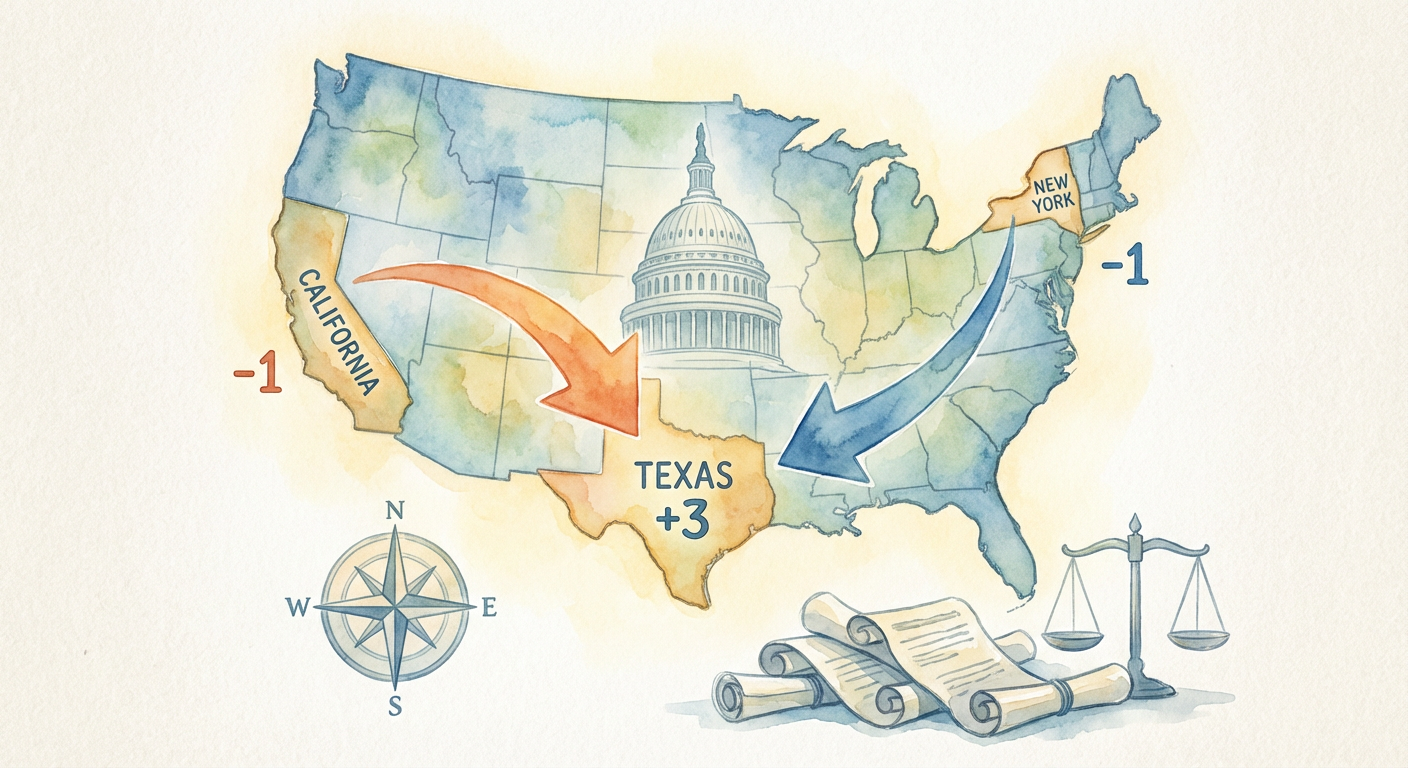
Texas is projected to gain three House seats. California and New York are each projected to lose one. Why? Population migration. People are moving south and west. But here’s where it gets interesting: the 2025 American Community Survey data from the Census Bureau shows that for the first time in American history, adults aged 18 to 34 outnumber Baby Boomers in 31 of the 50 states. This is an extraordinary demographic shift. In nearly two-thirds of the country, young voters are numerically dominant. But that dominance only translates into actual political power if they are accurately counted in the Census, and if that count accurately shapes redistricting maps. If you live in a state losing House seats because of undercounting in areas with high concentrations of young voters, your generation’s political weight gets physically removed from Congress.
The Money Follows the Numbers
Here is where the financial stakes become concrete. The Census determines not just representation but resources. Federal formula funding for education, infrastructure, Medicaid, housing assistance, and dozens of other programs is allocated based on Census population counts. A 2025 Urban Institute analysis found that a one percent undercount of low-income populations in the 2030 Census would result in approximately $1,800 per person annually in reduced federal formula funding flowing to those communities over the following decade. That is not a rounding error. For a low-income community with a population of 100,000, a one percent undercount means $180 million in cumulative funding losses over ten years. Schools get fewer resources. Public health programs get cut. Transportation infrastructure gets deferred.
Now connect this back to your generation’s lived experience. Young adults are more likely to live in rental housing, less likely to own homes outright, more likely to be geographically mobile. They are more difficult to reach through traditional enumeration methods. More likely to be missed in a census that relies on mail-back forms and limited follow-up. And because young adults are disproportionately concentrated in lower-income brackets compared to older age cohorts, undercounting of young adults directly reduces federal resources flowing to the communities where young people actually live.
The Methodology Question That Will Define Everything
This is where things get complicated. In late 2025, the Census Bureau announced a pilot program for new digital-first enumeration methods to be tested in 12 counties across five states ahead of the 2030 count. This is the most significant methodology test since the 2010 Census. What does that mean in practical terms? The 2020 Census relied heavily on mail-back forms, with follow-up visits for non-responses. The new methodology prioritizes online completion of census forms, using targeted digital outreach to identify and count hard-to-reach populations. On its face, this sounds sensible. Digital-first methods are potentially more efficient and cost-effective. But they also introduce new vulnerabilities. Visit the U.S. Census Bureau: 2030 Census Planning website and you will see the official parameters. Then ask yourself: who is most likely to respond to a digital-first enumeration? The answer is straightforward. People with reliable broadband access. People with devices. People comfortable conducting government transactions online. Not everyone fits that profile.
Young adults, statistically speaking, should have advantages in digital-first enumeration. You are the most connected generation. But young adults experiencing homelessness, young adults in rural areas with poor broadband infrastructure, young adults in institutional settings—none of them benefit from this shift. If the methodology pilot in 12 counties reveals that digital-first methods increase response rates among connected young professionals while decreasing response rates among young people in precarious circumstances, then the 2030 Census will have chosen a methodology that selectively undercounts the most vulnerable members of your generation.
What You Actually Need to Know Right Now
Three things. First, the decisions being made about Census staffing, methodology, and budget are not locked in. They can be influenced. Your state representatives and senators can pressure the Census Bureau for adequate staffing and transparent testing of new methodologies. Your communities can prepare to engage in enumeration outreach. You can demand accountability. Second, the 2030 Census will directly determine your generation’s political representation and your communities’ access to federal resources for the next decade. The connection is mechanical and direct. Third, you have a window of time to pay attention. By 2027, the methodology will be set. By 2028, the actual enumeration process will begin. If you wait until then to care about Census accuracy, you have missed your chance to shape the outcome.
What specific aspects of the 2030 Census concern you most? Which communities do you think are most likely to be undercounted? I want to hear your thoughts.